Blueberry Rosemary Crumble Cheesecake
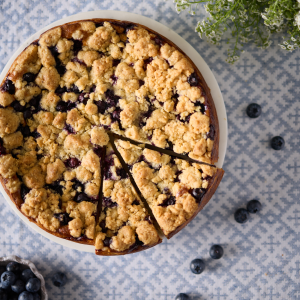
A blueberry rosemary crumble cheesecake inspired by Northern European baking traditions. Made with traditional ricotta instead of cream cheese, this easy gluten-free blueberry cheesecake layers fresh blueberries, lemon, and rosemary under a buttery crumble topping. A lighter, low sugar blueberry ricotta cheesecake recipe that’s simple, elegant, and deeply flavourful.
Equipment
- 23cm x 7cm springform pan
- Digital scales
- Microplane
- Medium mixing bowl
- Large mixing bowl
- Coarse mesh strainer or sieve
- Small saucepan
- Silicone spatula
- Electric hand mixer or stand mixer (optional)
- Instant read thermometer (optional)
- Baking tray (optional)
- Silicone mat (optional)
- Pizza slide (optional)
Ingredients
Cheesecake ingredients:
- 150 g granulated white sugar
- 1 T lemon zest (2 large lemons)
- 2 tablespoons corn starch
- ¾ teaspoon salt
- 750 g traditional ricotta cheese
- 4 large eggs + 1 yolk
- 150 g full fat sour cream
- 225 g blueberries
Crumb ingredients:
- 65 g almond flour
- 50 g rice flour
- 20 g corn starch
- ¼ teaspoon salt
- 2-4 sprigs fresh rosemary
- 65 g butter
- 65 g raw sugar
Instructions
- Get organised: Have your digital scales, mixing bowls, silicone spatula, and electric hand mixer or stand mixer ready. Get out all ingredients before you start.
- Preheat the oven to 150°C fan or 170°C conventional.
- Prepare the pan: Line a 23cm x 7cm springform pan. Lightly grease the sides with butter or spray oil.
- Turn the removable base upside down so the flat side faces up, then line it with a sheet of baking paper that overhangs by at least 5cm.
- Attach the ring and secure it in place.
- Cut a strip of baking paper about 9cm high and line the sides, pressing gently to adhere.
- Set the pan on a baking tray lined with a silicone mat to make it easier to move in and out of the oven.
- Make the crumble: Sift 65g almond flour, 50g rice flour, 20g corn starch, and ¼ teaspoon salt into a medium mixing bowl using a coarse mesh strainer or sieve, breaking up any lumps of almond flour.
- Finely chop the leaves from 2–4 sprigs of fresh rosemary, avoiding any woody stems.
- In a small saucepan, melt 65g butter over medium-low heat with the chopped rosemary, stirring to infuse. Remove from the heat and stir in 65g raw sugar—do not dissolve it.
- Pour the butter mixture over the dry ingredients and mix with a silicone spatula until combined.
- Chill until firm, then break into small clusters. Keep refrigerated until needed.
- Make the cheesecake batter: In a large mixing bowl, combine 150g granulated white sugar and the zest of 2 large lemons (about 1 tablespoon).
- Beat together for 3–5 minutes using an electric hand mixer or stand mixer until the sugar is fragrant and slightly damp from the lemon oils.
- Add 750g traditional ricotta cheese and 150g full-fat sour cream to the sugar mixture.
- Separate 5 eggs, setting 4 whites aside.
- Add the 5 yolks to the bowl and beat on low. Sprinkle in 2 tablespoons of corn startch and continue on medium speed until the batter is fairly smooth and well combined.
- In a clean mixing bowl, whisk the 4 reserved egg whites to firm peaks.
- Add one-quarter of the whipped egg whites to the ricotta mixture and mix well to loosen the batter. Then gently fold in the remaining egg whites in three additions using a silicone spatula or large metal spoon, stopping as soon as they are fully incorporated.
- Assemble the cheesecake: Spoon the batter into the prepared springform pan and level the top with an offset spatula.
- Tap the pan gently on the bench once or twice to remove air bubbles.
- Scatter 225g fresh blueberries evenly across the surface.
- Break up the chilled crumble into small clusters and sprinkle them evenly over the top, without pressing down.
- Bake the cheesecake: Place the assembled cheesecake in the preheated oven and bake on the middle or top rack and bake for appriximately 60-65 minutes
- Ricotta-style cheesecakes are typically set at 65–68°C internally, but for this Northern European style cheesecake, bake until the crumble is golden and the centre reaches about 80–85°C when tested with an instant-read thermometer. The sides should be firm and the centre should still have a slight wobble.
- Cool and unmould: Remove from the oven and cool completely at room temperature.
- Once cool, release the sides of the springform pan and peel away the baking paper.
- Because there’s no base, use a pizza slide to help transfer the cheesecake to a serving plate if needed. Chilling the cheesecake briefly before moving it makes the process easier.
Just before you cook with abandon…
Room temperature ingredients: For a smooth, even batter, bring the ricotta, sour cream, and eggs to room temperature before mixing. Cold ingredients can cause the batter to split and trap excess air, which affects texture. If you forget, place the ricotta and sour cream (weighed out) in a warm oven—no higher than 30°C—for 5–10 minutes, and warm the eggs (in their shells) in a bowl of hot water for a few minutes. The butter for the crumble doesn’t need to be softened—it’s melted anyway.
The right ricotta: Avoid smooth or spreadable ricotta. You need the traditional, firm curd-style version sold in the draining tubs or sitting up in the deli. It’s what gives this low sugar blueberry ricotta cheesecake recipe its texture and structure.
European curd cheese substitutes: If you have access to Quark, Tvorog, or Kodujuust, use them—but choose the firm curd-style versions, not the whipped or yoghurt-like ones. These bake much like ricotta and stay light, not dense.
Rosemary choice: Use the softer tips of the rosemary stems rather than woody ends. They’re more aromatic and soften during baking. Blitzing or very finely chopping the leaves ensures the flavour carries evenly through the crumble without coarse specks.
Raw sugar vs white sugar in the crumble: Stick with raw sugar. The larger crystals resist dissolving and create a crisp, textured topping. Granulated sugar won’t give the same result.
No need for a base: A cheesecake base almost always ends up soggy. The crumble gives you the crunch where a base fails—it bakes up golden and stays crisp for days.
Oven temperature and placement: Bake at 150°C fan or 170°C conventional, ideally on the top third rack. This helps the crumble brown evenly while keeping the filling tender.
Doneness check: For a ricotta-based cheesecake, aim for an internal temperature of 80–85°C when using an instant-read thermometer. The sides should be set and the centre should have a gentle wobble. It will firm as it cools.
Handling after baking: Because this cheesecake doesn’t have a base, take care when unmoulding. Once at room temperature, chill briefly before transferring with a pizza slide to prevent the bottom from breaking.
Storage: Store covered in the refrigerator for up to 4 days. Serve at room temperature for the best texture and flavour.
Freezer friendly: This blueberry rosemary crumble cheesecake freezes well, either whole or sliced. Once completely cool, wrap tightly in two layers of plastic wrap and place in a sealed freezer-safe container. It will keep for up to 2 months. To thaw, unwrap and leave at room temperature for 4–5 hours before serving. If freezing in slices, separate them with baking paper before wrapping so individual portions can be defrosted as needed.