Blueberry Rosemary Jam
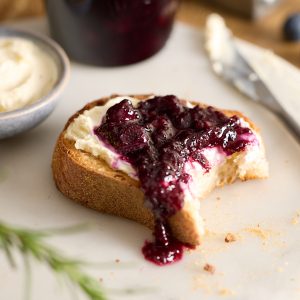
I’ve crafted this blueberry rosemary jam recipe to make sure that delicate fresh blueberry flavour doesn’t get lost along the way.First, most so-called easy blueberry jam recipes lean heavily on sugar—not just for sweetness, but also for setting and preservation. They use high methoxyl (HM) pectin, also known as high methyl ester pectin—the same kind you’ll find in supermarket “jam sugar.” But without a high proportion of sugar, HM pectin won’t set properly.
Equipment
- 4–5 litre heavy-based stainless-steel pot
- Ladle
- Wide-mouth jam funnel
- potato masher
- Cheesecloth
- Kitchen string
- Digital scales
- 3 x 250ml preserving jars with lids
Ingredients
- 500 g frozen blueberries
- 1 large granny smith apple
- 125 ml water
- 200 g raw sugar
- 1-2 sprigs fresh rosemary
- ½ teaspoon lemon zest
- ¼ teaspoon table salt
- 1 teaspoon low methoxyl pectin
- 1 teaspoon calcium water
- 1 tablespoon + 2 teaspoons lemon juice
Instructions
Prep the blueberry rosemary jam ingredients:
- Defrosts 500g frozen blueberries.
- Prepare calcium water by measuring 125ml water that has been boiled and cooled into a clean container with a lid. Add ½ teaspoon calcium powder. Shake well. And don’t forget to shake the container again just before adding the calcium water to the jam—otherwise the calcium settles at the bottom.
- Zest and juice the lemon and set aside 1 tablespoon plus 2 teaspoons lemon juice and ½ teaspoon packed lemon zest.
- Peel the apple and grate on a coarse grater, discarding the core. Drizzle the peeled apple with a little leftover lemon juice and toss some juice through the grated apple.
- In a small bowl, stir 1 teaspoon LM pectin into 100g of the 200g raw sugar and mix well to distribute the pectin evenly through the sugar. This prevents clumping when added to the hot fruit mixture later. Set aside the remaining 100g of sugar.
- Wrap 1–2 sprigs of fresh rosemary in three layers of cheesecloth and tie securely with kitchen string. This makes it easy to remove later while still allowing the rosemary oils to infuse into the jam.
Combine the fruit and aromatics:
- Add 500g frozen blueberries (defrosted), grated apple, ½ teaspoon packed lemon zest, and the prepared rosemary bundle to a 4–5 litre heavy-based stainless-steel pot.
- Pour in 125ml water, then place the pot over medium-high heat.
- As the berries begin to release their juices and come to a simmer, use a potato masher to crush some of the blueberries—just enough to release juice and texture. Leave a few whole berries so the jam has visible pieces of fruit.
- Occasionally press the rosemary bundle with the masher to release more flavour.
Bring to a boil and add pectin mixture:
- Once the blueberries are simmering, remove the rosemary bundle.
- Increase the heat to high and gradually add Sugar No.1 (100g raw sugar mixed with 1 teaspoon low methoxyl pectin), stirring constantly with a wooden spoon or silicone spatula to distribute the pectin evenly. Stir for about 90 seconds.
- Add 1 teaspoon calcium water and 1 tablespoon plus 2 teaspoons lemon juice to the pot, stirring well to combine.
- Next add Sugar No.2 (the remaining 100g raw sugar).
- Continue stirring and bring the jam to a rolling boil—meaning the mixture continues to boil even while being stirred. Keep it at this stage for 90 seconds to two minutes.
- Boil just long enough for the jam to turn glossy and deep purple.
- Remove from heat. A light foam may form on top—skim it off with a spoon or stir in 1 teaspoon butter if you don’t need the jam to stay vegan.
Jar and store:
- Ladle the hot jam into sterilised jars or containers using a wide-mouth funnel, leaving 5–10mm of headspace at the top.
- Wipe the rims clean with a damp cloth and secure the lids until just tight.
- If consuming within two weeks, let the jars cool on a tea towel and refrigerate. For longer storage, process the jars in a boiling water bath as outlined in the notes.
Freezing option:
- For freezer jam, let the mixture cool until just warm.
- Spoon the jam into freezer-safe containers or bags, removing as much air as possible.
- Lay flat on a tray to freeze, then stack once solid.
Just before you cook with abandon…
Frozen blueberries are best for this recipe
Yes, in this case fresh is not best—and what a relief considering how expensive fresh blueberries can be. Those supermarket punnets have been hand selected for their perfection, so why would you want to mash them into a jam? You want the berries that didn’t make the cut and ended up frozen in your jam.
And there’s a solid reason for using frozen berries in your blueberry rosemary jam. The freezing causes the cells of the berries to rupture, allowing the juice to be released and softening the fruit. This means it will take less cooking time to break down the blueberries, helping preserve their fresh, natural flavour in the final jam.
Low methoxyl pectin with calcium
My low sugar blueberry jam recipe does have one specialty product that you’re not going to find on supermarket shelves—the low methoxyl (LM) pectin. The best known brand is Pomona’s Universal Pectin, which comes from the USA and is available on Amazon in Australia. But we also have a local supplier here in Queensland—Green Living.
What makes low methoxyl pectin different?
Unlike high methoxyl (HM) pectin, LM pectin doesn’t rely on sugar or temperature to set—it relies on calcium. That’s why this jam works with far less sugar. LM pectin gels between 50°C and 70°C, triggered by the calcium reaction rather than the sugar concentration. So you don’t have to worry about thermometers—it’s more forgiving and flavour-friendly.
Preparing calcium water
To activate the LM pectin, you’ll need calcium water. Most LM pectin is sold with calcium powder in a separate packet. Combine ½ teaspoon calcium powder with 125ml boiled and cooled water in a clean jar with a lid. Shake well and store in the fridge for up to two months. Shake again before each use—calcium settles easily at the bottom.
Exactly how low sugar can I go?
The LM pectin method of making low sugar blueberry jam leaves it up to you to decide how much sugar to add. The recipe does need some sugar to help the pectin distribute evenly through the fruit and avoid clumping. I use 200g raw sugar for 500g blueberries to help ramp up depth of flavour in the final jam. Traditional jams use a 1:1 ratio of fruit to sugar. Here, I’ve adopted a 1:0.4 ratio of fruit to sugar (500g blueberries and 200g sugar). This balance keeps the blueberry flavour bright and natural without leaning too sweet.
Can I use sugar substitutes?
You can use sugar substitutes—but I would not recommend them with this jam as they have a lingering aftertaste that would overwhelm the delicate blueberry flavour. I was not happy with the result when I tried the recipe with xylitol. You can experiment with other sweeteners like coconut sugar, honey, or maple syrup, though you’ll need to adjust the volumes to suit your preferred sweetness and palate.
Sterilising and storage
Whether you’re refrigerating, freezing, or processing your jam, clean jars and utensils are non-negotiable. If you’re planning to consume the jam within two weeks, a thorough clean and hot rinse will do. For longer storage, sterilise the jars and process the filled jars in a boiling water bath as outlined below.
Why use fresh rosemary?
If you’re wondering whether dried rosemary will do—don’t. Use fresh rosemary sprigs. The essential oils in the leaves are what carry its aromatic character, and those oils are the key to how the savoury herbal note weaves through the jam. Dried rosemary has lost those volatile oils and leaves behind a dull, woody flavour instead of the fresh perfume that gives this easy blueberry jam recipe its depth.
What is a rolling boil?
A ‘rolling boil’ is a technical term when you’re making jam! You’ve achieved a rolling boil at the point when the jam keeps boiling even though you’re stirring it. You want the heat on high to achieve a full rolling boil and you need to keep stirring to ensure the jam does not catch.
Foam or no foam: A light foam forms naturally as the jam boils. You can skim it off before ladling into jars, or stir in 1 teaspoon butter to disperse the foam (if you don’t need the jam to stay vegan). The butter helps the foam disappear and gives the surface of the jam a beautiful gloss.