Easy Moroccan Preserved Lemons
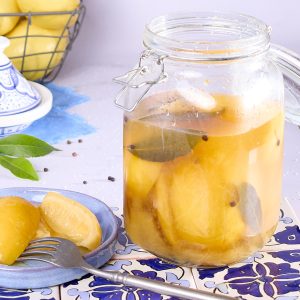
My Easy Moroccan Preserved Lemons recipe is a gentle introduction to fermentation with none of the scary bits! It’s a perfect recipe for those Australians and New Zealanders who have a lemon tree in their garden. And there’s no problem using the same technique for limes. When you think your dish needs a squeeze of lemon, think twice and choose preserved lemons. They still deliver the citrus flavour but combined with the floral notes of the lemon peel and a good hit of umami that comes with the fermentation process.
Equipment
- 1 litre preserving jar with lid
Ingredients
- 6 large lemons
- 3 large lemons (for juice)
- 3 bay leaves
- 2 tablespoons black peppercorns
- 500 g cooking salt
Instructions
- Assemble ingredients.
- Sterilise preserving jar, lid and sealing ring (if using) according to your preferred method (see notes).
- Wash and dry lemons.
- Start with 6 lemons. Using a sharp knife, cut a small slice off each end of the lemon. Stand each lemon up on end, cut through the lemon, stopping about 2 centimetres short of the other end. Make another cut so the lemon is (almost) cut into quarters. Repeat for each lemon.
- Pack the gaps between the lemon sections with cooking salt and then add to the jar.
- Pack the lemons as tight as possible. You may need to cut some lemons in half as you pack them into the jar.
- As you pack in the lemons, use a wooden spoon or rolling pin to press out as much juice as possible.
- Add a bay leaf and peppercorns, along with a generous amount of salt before packing in the next layer of lemons.
- Leave a 1 centimetre gap at the top of the jar. Seal the jar tightly with its lid. At this stage the lemon juice will not fill the jar.
- Put the sealed jar of lemons in the fridge for 5 days. Turn upside down and back upright once a day or so.
- On day 5, squeeze the remaining 3 lemons and use the juice only to top up the jar 1 centimetre from the top. You may need more than 3 lemons. Tip the jar over a couple of times to make sure the existing brine thoroughly mixes with the new lemon juice.
- Leave the jar in the fridge for 3-4 weeks, there is no need to keep turning the contents.
- The preserved lemons are ready to use when the lemons are a deep yellow, the brine looks thick and slightly opaque and the lemon peel texture has transformed into a soft and slightly plump texture.
Just before you cook with abandon…
Sterilising preserving jar: Each sterilising method starts with washing the jar, lid, and any seal in hot soapy water and rinsing them well. Here are a few methods:
- Steaming method. Steam the jars, lids and sealing ring (if using) at 100°C for 5 to 10 minutes. Carefully remove the jar and let it cool right side up on a clean tea towel.
- Boiling water method. Use boiling water from a kettle and fill the jar, leaving it to cool on the bench. Put the lid and any silicone/rubber seal in a heat proof container and pour boiling water over them, again leaving them to cool in the water.
- Oven method. Preheat the oven to 135°C and place the clean jar and lid on a baking tray. Heat in the oven for 20 minutes, turn off the oven and leave the jar and lid in the oven to cool. If you are using a rubber sealing ring, don’t put it in the oven. As above, put it in a bowl and pour boiling water over it and then leave it to cool in the water.