Moroccan Kitchen Sink Salad
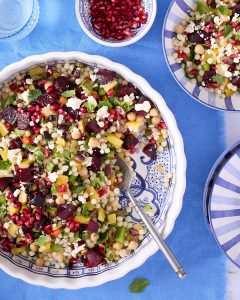
There’s something magical about Moroccan cuisine—the way it effortlessly balances sweet and savory, earthy and bright, crunchy and tender. This Moroccan-inspired kitchen sink salad is a perfect example of that harmony, bringing together bold flavours, vibrant colours, and a satisfying mix of textures in every bite. This isn’t your average salad. It’s a feast of flavours, starring pearl couscous for heartiness, chickpeas for protein, and a dazzling array of vegetables and fruits that make every forkful an adventure. Roasted beets lend a deep, earthy sweetness, while preserved lemons provide a burst of briny citrus. The addition of currants steeped in apple cider vinegar gives a subtle tang, while pistachios add crunch, and pomegranate arils pop with juicy sweetness. Tossed with a fragrant blend of fresh mint and coriander, and finished with creamy feta, this salad is a true celebration of Moroccan-inspired ingredients.
Equipment
- Colander
- Sieve
- Meat mallet or a heavy wooden rolling pin
- 5-6 litre sealed plastic container (optional)
- Large serving bowl or platter
Ingredients
Salad ingredients:
- 300 g pearl couscous
- 1 cup currants
- 250 ml apple cider vinegar
- 400 g tinned chickpeas
- 2 large fresh beetroots
- 3 large capsicum (one each of yellow, red, green)
- 2 large preserved lemons
- 1 large pomegranate
- 1 cup shelled pistachios
- 1 small bunch coriander
- 1 small bunch mint
- 100 g feta cheese
Dressing ingredients:
- 60 ml reserved currant vinegar
- 60 ml fresh lemon juice
- 100 ml extra virgin olive oil
- 1 tablespoon honey
- 1 tablespoon pomegranate molasses
- ½ teaspoon Dijon mustard
- Sea salt
- Black pepper
Instructions
Roasted beetroot
- Preheat oven to 200°C /180°C fan forced.
- Peel the beetroot and cut them into thick batons about 2-3cm thick.
- Place the batons on baking paper on a baking sheet and drizzle with olive oil. Lightly salt and pepper. Roast for 10 minutes and then start checking every 5 minutes. Set a timer to avoid overcooking the beetroot. Takes approximately 20-30 minutes.
- The beetroot is done when a fork can easily pierce the beetroot. Set aside to cool.
Pearl couscous
- Meanwhile, bring at least 3 litres of salted water to a boil in a large pot on high heat.
- Add the couscous and cook at a rolling boil, stirring occasionally to stop the couscous from sticking to the bottom of the pan.
- Follow the packet instructions, checking regularly, so the couscous doesn’t overcook.
- It should take 10-15 minutes and the couscous should be slightly al dente like pasta.
- Drain the cooked couscous in a colander and rinse well with cold water. Set aside.
Sour currants
- Heat 250mls of apple cider vinegar in the 500ml microwave jug or in a small pot until hot but not boiling.
- Add the currants and set aside to steep and plump up.
- Once plump, drain the vinegar off through a sieve.
- Reserve the ‘currant vinegar’ for the dressing.
Prep remaining salad ingredients
- Prep remaining salad ingredients and set aside for salad layering or assembly.
- Dice capsicum into approximately 1 centimetre squares.
- Drain the tinned chickpeas and set aside, discarding the fluid.
- Prepare 2 large preserved lemons by removing the lemon segments, leaving only the rind. Rinse the rind briefly under cold running water to remove the salt brine and pat dry.
- Dice the preserved lemon rind to a similar size as the capsicum.
- Prepare the fresh coriander and mint by picking the leaves from the stems and discarding the stems. Any large leaves can be torn or roughly chopped.
- The aerials need to be removed from the pomegranate. Cut the pomegranate in half through the middle. Then, using a large bowl to catch the aerials, hold the half cut side down in your fingers. Hit the back of the pomegranate with a meat mallet or a heavy wooden rolling pin. The aerials will fall through your fingers.
Salad dressing
- Combine the dressing ingredients and whisk by hand, shake them in a sealed container, or blend them with an immersion blender or small food processor for an ultra-emulsified finish.
- Salt and pepper to taste.
- Set it aside until you’re ready to layer or toss the salad.
Assemble salad
- Set aside 1/3 each of the beetroot dice, currants, capsicum dice, pistachios and pomegranate aerials to use to garnish the salad.
- Set aside all the feta cheese.
- If making the salad in advance, assemble into a sealed container in layers, refrigerate, and toss just before serving.
- Start layering in container. Start with half the dressing. Reserve half the dressing to ensure the salad is not soaking in dressing. You can adjust the amount of dressing just before serving.
Then add the salad ingredients in the following order:
- Beets.
- Cooked couscous.
- Chickpeas.
- Capsicum.
- Currants and pistachios.
- Pomegranate aerials.
- Coriander and mint leaves.
- When ready to serve, toss all the ingredients together and add more dressing if required.
- Place salad in a large serving bowl or on a platter.
- Top with crumbled feta cheese and the other reserved ingredients.
Just before you cook with abandon…
Wash before prepping: Please note that washing in cold water and drying herbs and non-peelable fruit and vegetables is assumed. I use a salad spinner for herbs and then roll them between paper towels to absorb the excess water. You can also submerge herbs in a bowl of cold water, shake them off and then roll in a clean tea towel or paper towels.
Virtually vegetarian: With the exception of the feta cheese this Moroccan-inspired salad recipe is vegetarian and would also suit vegetarians who are happy to eat non-meat animal products (NMAPs).
Make it vegan: You can swap in any vegan cheese or just leave out the feta cheese and you have a vegan Moroccan salad recipe. Both the pearl couscous and chickpeas are plant based proteins.
Make it a day ahead: Making this salad a day ahead of your planned meal makes the prep time so much more relaxed. I prepare all the elements and layer them into a large, sealed plastic container and refrigerate overnight. Specifically with this Moroccan-inspired kitchen sink salad I layer in the following bottom up order:
- half the dressing
- beets
- cooked couscous
- chickpeas
- capsicum
- currants and pistachios
- pomegranate aerials
- coriander and mint leaves