Blueberry Cheesecake Kolaches
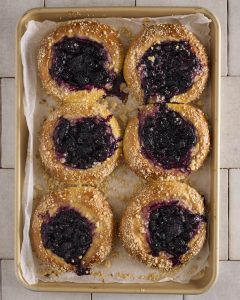
Traditional Czech fillings for kolaches include a fresh curd cheese (tvaroh), poppy seeds, fresh fruit and plum jam. I've swapped in a filling that layers cheesecake with my blueberry rosemary jam. The buns are sprinkled with a cinnamon crumble before baking. The Czechs call their streusel-style topping posypka.
My method is really straightforward and I've worked in a chefy technique that makes filling the buns foolproof. I think they bake up beautifully – as soon as they're out of the oven you can see just how delicious they are going to taste. The jam finds the low side of every bun and I've stopped fighting it.
Equipment
- Stand mixer (with paddle and dough hook attachments)
- Microplane
- Digital kitchen scales
- Instant read thermometer
- 12 silicone moulds 6.5cm diameter cavities each (silicon muffin moulds, hemisphere moulds, etc)
- Piping bage (optional)
Ingredients
Foundation sweet dough
Tangzhong:
- 35 g all-purpose flour
- 120 g full cream milk
- ½ teaspoon table salt
Dough:
- 60 g white sugar
- 2 oranges
- 350 g full cream milk
- 1 large egg
- 575 g all-purpose flour
- 1 tablespoon instant yeast
- 115 g unsalted butter
Blueberry rosemary jam:
- 350-400 g blueberry rosemary jam
Lemon cheesecake filling:
- 225 g original Philadelphia cream cheese
- 75 g white sugar
- 1 egg yolk
- 1 lemon
- ¼ teaspoon table salt
Cinnamon crumble:
- 100 g all-purpose flour
- 50 g raw sugar
- 50 g unsalted butter
- ¼ teaspoon cinnamon
- Pinch of table salt
Egg wash:
- 2 egg yolks
- 2 tablespoons cream (or milk)
Instructions
What to make ahead
Blueberry rosemary jam:
- Make the blueberry rosemary jam. It can be made weeks in advance and keeps in the fridge.
Lemon cheesecake filling:
- Weigh 75g white sugar into the bowl of a stand mixer and zest the lemon over the bowl using a Microplane.
- Using the paddle attachment, mix the sugar and zest on medium for 2 minutes.
- Add 225g Original Philadelphia cream cheese, 1 egg yolk, and ¼ teaspoon table salt to the bowl. The cream cheese can be cold straight out of the fridge.
- Start the mixer on low and increase briefly to medium until the cheesecake batter is smooth.
- Transfer to a medium sized piping bag (optional) and refrigerate.
Freezing the filling inserts:
- Place each set of six 6.5cm diameter hemisphere silicone moulds on a baking tray to keep them level.
- Pipe or spoon 1½ tablespoons of the cheesecake mixture into each mould. Spread gently with an offset spatula and drop the tray onto the bench a couple of times from a height of about 15cm.
- Spoon 1½ tablespoons of blueberry rosemary jam over the cheesecake and level with an offset spatula, taking care not to mix the two layers.
- Freeze until solid, keeping the trays level. Keep frozen until ready to fill the proved buns.
Cinnamon crumble:
- Sift 100g all-purpose flour, ¼ teaspoon cinnamon, and a pinch of salt into the bowl of a stand mixer. Add 50g raw sugar and mix on low with the paddle attachment until combined.
- Add 50g slightly soft unsalted butter and mix on medium-low until just combined.
- Break up any large lumps, then refrigerate the crumble in a sealed container.
Make the tangzhong:
- Weigh 35g all-purpose flour and 120g full cream milk into a small pan and add ½ teaspoon table salt.
- Heat over medium low heat while whisking until the mixture forms a thick paste.
- Remove from the heat, transfer to a small bowl or container and chill until slightly cold.
Make and knead the foundation sweet dough:
- Weigh 60g white sugar into the bowl of a stand mixer and zest 2 oranges over the bowl using a Microplane.
- Using the paddle attachment, mix on medium for 2 minutes until zest is well incorporated into the sugar.
- Add the tangzhong, 350g full cream milk, 1 large egg, 575g all-purpose flour, and 1 tablespoon instant yeast.
- Mix on low with the dough hook until combined.
- Increase speed to medium and knead for at least 5 minutes to develop the gluten. You want it to stretch and not tear immediately if you test a small piece of the dough.
- Turn the speed back to low and add 115g slightly chilled unsalted butter, cut into tablespoon sized pieces, a couple of pieces at a time. Wait until each addition is incorporated before adding more. This can take up to 10 minutes.
Forming the dough ball:
- Tip the dough onto the bench. Pick a side to be the top of the dough ball and keep it that way.
- Lift the dough off the bench, stretch it out and drop it back down, gathering it back into a ball with a dough scraper.
- Repeat until the dough becomes less sticky and more resistant.
- Then lift the dough about 30cm off the bench, letting it stretch into a tail, flip the tail forward as you land it, roll the dough over and tuck it in, keeping the top facing up. Tuck in around the base with the scraper and repeat a couple of times.
- The dough is ready when it releases cleanly from the bench and springs back when pressed.
- Lift into a greased bowl, cover with an oiled sealed lid or oiled plastic wrap.
- Refrigerate overnight, up to 12 hours.
On the day you bake
Get organised:
- Set up your proving environment before taking the dough out of the fridge.
- Set the oven to 30°C.
- Line 2 large rimmed baking trays with baking paper.
Assembling the blueberry cheesecake buns:
- Weigh the risen dough, which should be approximately 1300g. Aim for 100g portions, allowing for some wastage or some extra dough being added to a portion.
- Weigh off a 100g portion and form the buns one at a time.
- On the bench, first stretch a corner of the dough out and press it back into the centre in one movement, rotating a quarter turn each time, repeat this seven times.
- Then place the dough ball pinched side down and, with your fingers cupped over the ball like a cage, roll it vigorously in small circles without compressing it. This helps create tension on the surface of the ball.
- Finally, shake a little flour over the bench and the dough and use a rolling pin to flatten the dough ball slightly to form a disc.
- Place each disc of dough on the lined trays, evenly spaced, six per tray in two rows of three.
Prove the buns:
- Transfer the trays to your proving set up and prove until the buns are just under doubled in size, around 40 to 45 minutes.
- Meanwhile, prepare the egg wash by beating 2 egg yolks and 2 tablespoons cream or milk together in a small bowl.
Fill the buns:
- Preheat the oven to 165°C fan forced.
- Once the buns are proved, use a silicone pastry brush to cover each bun with egg wash, brushing any drips that pool at the base up the side of the bun.
- Unmould the frozen filling inserts, running an offset spatula around the inside of the mould if needed.
- Firmly press one insert into the centre of each disc of dough, jam side up. Be careful to note when you start to feel the bottom of the tray—don't press the filling through the base of the bun. The insert may sit slightly above the dough, which is fine.
- Egg wash the exposed dough a second time.
- Generously sprinkle the cinnamon crumble over the exposed dough, avoiding too much landing on the inserts.
Bake:
- If baking in one oven over two racks, place one rack in the top third and one in the bottom third. While baking, swap and rotate the trays 180 degrees when the top tray starts to turn golden.
- If baking across two ovens, use the middle rack and rotate the trays 180 degrees halfway through.
- Once the trays are in the oven, immediately turn the temperature down to 155°C fan forced.
- Bake for around 25 minutes.
- The frozen insert needs to defrost before the cheesecake filling starts to bake, so don't rush the buns out of the oven.
- When they're golden brown, test the internal temperature of the bun, which should be 88 to 91°C, then double check that the centre of the insert has reached 68°C. It will come up to 71°C with residual heat.
Just before you cook with abandon…
Get organised: Mise en place, or putting in place, is harder when a recipe runs across two days, so treat it as two lots of being organised. Weigh and set out each component as you make it, and on bake day get your proving environment set up and your trays lined before the foundation sweet dough comes out of the fridge. The dough is easiest to handle while it's still cold, and that window closes while you're hunting for a rolling pin.
Digital scales: If you are going to bake, you need a kitchen scale. It's really in the necessity column not the optional column. You don't need to spend a fortune on them; decent ones can be bought for about $70. I find the expensive ones break down just as quickly as the cheaper versions. But I would recommend you go for a known brand from a reputable kitchen shop. For this recipe you'll also use it to weigh the risen dough before dividing it into twelve equal 100g balls.
Tablespoons: I use 15ml tablespoons in my baking recipes. If yours are 20ml, the filling quantities will run out before the twelfth bun.
Make ahead: The blueberry rosemary jam can be made a couple weeks in advance and kept in the fridge. The night before you bake, make the lemon cheesecake filling, assemble and freeze the filling inserts, make the cinnamon crumble, and get the dough into the fridge for its overnight rest. That leaves shaping, proving and baking for the day itself.
Proving without a proving oven: I use two very large sturdy plastic bags (70cm x 80cm), one per tray, inflated so they don't catch on the dough, and prove in two ovens set to 30°C. Your trays will be fine on two racks in a warm oven without the bags — add a bowl of just boiled water in the corner of the oven if you want the humidity. Large sealed plastic storage containers on the bench work too. And if it's January in Australia, the bench is fine on its own but just cover the dough with a sheet of oiled plastic wrap or a cut open oiled plastic bag so the formed kolaches don’t form a skin as they prove.
Silicone moulds: I've used two moulds of six 6.5cm hemispheres, but there are lots of silicone shapes you can use to form the inserts. Silicone dariole moulds, silicone mini muffin baking cups or a large silicone ice cube tray all work. Whatever you use, keep the cheesecake and the jam layers separate, with the jam side up the same way it goes into the bun.
Storage: The tangzhong method used in these buns helps keep them fresh — moist and fluffy — for a couple of extra days. I keep them in the fridge in a sealed container and refresh them with a few minutes in a low oven at around 120°C until they're warmed through.
Freezing: These Blueberry Cheesecake Kolaches freeze really well in a sealed container. When you remove one from the freezer, microwave it for 30 seconds on high and then pop it in a low oven at around 120°C until it's warmed through.