Lemon Blueberry Rosemary Bundt Cake
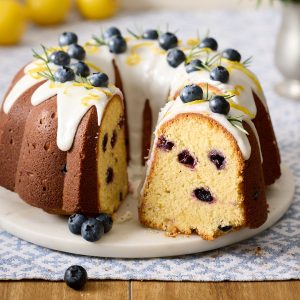
This lemon blueberry rosemary bundt cake is my modern pound cake recipe. Fresh rosemary in the batter brings an almost undetectable savoury note, adding aromatic complexity and softening the sugar hit. The result? Bright with lemon, dotted with blueberries, and just that little bit more sophisticated—yet still an easy lemon blueberry bundt cake.
Equipment
- Bundt pan (10-cup / 2.5-litre capacity)
- Digital scales
- Stand mixer with flat paddle attachment (or handheld electric beaters)
- 1 litre pouring jug
- Coarse sieve
- fine sieve
- Microplane
- Spice grinder (optional)
- Pastry brush
- Offset spatula (optional)
- Ice cream scoop (optional)
- Cake tester or long skewer
- Instant read thermometer (optional)
- cooling rack
Ingredients
Bundt cake:
- 4 tablespoons lemon zest
- 4-6 sprigs fresh rosemary
- ¾ teaspoon salt
- 380 g unsalted butter
- 135 g almond flour
- 100 g full fat Greek yoghurt
- 140 g egg yolks
- 140 g whole eggs
- 520 g cake flour
- 2 ½ teaspoons baking powder
- 80 g lemon juice
- 150 g fresh blueberries
Lemon royal icing and décor:
- 250 g pure icing sugar
- 4 teaspoons lemon juice
- 4 teaspoons glucose syrup
- 60 g fresh blueberries
- 1 sprig fresh rosemary
- 200 g granulated white sugar (optional)
Instructions
Get organised:
- Prepare all equipment and ingredients before starting.
- Bring butter, eggs and yoghurt to room temperature before baking.
- Weigh each ingredient and portion into separate bowls if not being added directly to the mixing bowl.
- Preheat the oven: Preheat the oven to 155°C fan or 175°C conventional.
Prepare the Bundt pan:
- Grease a 10-cup (2.5-litre) Bundt pan with a spray oil containing flour and use a pastry brush to spread the oil evenly into all crevices.
- Invert the pan to drain excess.
- Alternatively, brush lightly with vegetable oil, dust with sifted flour, and tap out any excess.
Start with the sugar:
- Zest 4 lemons (about 2 tablespoons zest) and finely chop 2 tablespoons fresh rosemary.
- Combine the lemon zest and rosemary with 380g granulated white sugar in the bowl of a stand mixer.
- Beat with the flat paddle attachment on medium speed for 3–4 minutes.
Complete the batter:
- Add 380g softened unsalted butter and ¾ teaspoon salt to the sugar mixture.
- Beat on medium speed for 3–4 minutes until pale and fluffy.
- Sift in 135g almond flour through a coarse sieve and beat in until incorporated.
- In a 1-litre pouring jug, whisk 140g egg yolks, 140g whole eggs, and 100g full-fat yoghurt. Add the egg mixture in batches to the stand mixer, beating on medium between each addition until combined.
- Sift 520g cake flour and 2½ teaspoons baking powder in a separate bowl. Add to the batter in three batches, beating on low until just combined each time.
- Add 80g freshly squeezed lemon juice and beat on medium for up to 30 seconds batter is smooth.
Filling the Bundt pan:
- Toss 150g fresh blueberries in a little flour.
- Layer the batter into the prepared Bundt pan using an ice cream scoop. Smooth each layer with an offset spatula, tapping the pan gently on the bench to remove air pockets.
- Scatter blueberries evenly between layers—avoiding the blueberries making contact with the sides of the pan.
- Press the final blueberries lightly into the top of the batter.
- The batter should finish about 2cm below the rim of the pan.
Baking the Bundt cake:
- Bake for 60–65 minutes at 155°C fan (175°C conventional).
- Begin testing at 55 minutes.
- The cake is done when a skewer inserted into the deepest part comes out with a few moist crumbs. For accuracy, test in three places.
- If using an instant-read thermometer, the cake is ready at 95°C.
Releasing the Bundt cake:
- Cool the Bundt in its pan on a cooling rack for 10–20 minutes.
- Place baking paper over the top, followed by the cooling rack. Invert the pan and rack together onto the bench and lift the pan gently. If the cake sticks, loosen the edges and centre with a small offset spatula before inverting again.
- See notes for troubleshooting.
Making the lemon royal icing:
- Sift 250g pure icing sugar into the stand mixer bowl.
- Add 2 teaspoons lemon juice and 4 teaspoons glucose syrup. Lightly spray the spoon with vegetable oil before measuring syrup to prevent sticking.
- Mix on low to medium-low with the paddle attachment until a smooth paste forms.
- Add additional lemon juice gradually until the desired viscosity is reached.
- Test by dripping a little icing onto an inverted bowl.
- If the icing is too thin, add more sifted icing sugar.
Decorating the Bundt:
- Once the cake is completely cool, spoon the icing over the top, allowing it to drip down the sides. Decorate with 60g fresh blueberries, 1 sprig fresh rosemary, and candied lemon peel.
Just before you cook with abandon…
Room temperature: When making cake, all ingredients should be at room temperature to prevent the batter from splitting and to ensure an even texture. I get the butter, eggs, and yoghurt out the night before. If I forget, I warm the weighed-out butter in a low oven (no higher than 30°C) for a few minutes—set a timer to avoid melting. Eggs (shell on) can be placed in a bowl and covered with hot water to bring to room temperature quickly.
Avoiding blueberries touching the pan: Keep the blueberries from touching the sides or base of the Bundt pan. Direct contact can cause the fruit to stick and tear the cake during release. Tossing the berries lightly in flour before adding them to the batter helps prevent them from sinking.
Bundt release troubleshooting: If the Bundt doesn’t release easily after cooling it in the pan for 10–20 minutes, loosen the external and internal edges gently with a small offset spatula. Invert again and let gravity do its work. As a last resort, hold the pan and rack together and give them a firm tap on the bench. Missing chunks can always be disguised with a bit of creative icing and décor.
Wash before prepping: Herbs and non-peelable fruits should be washed in cold water and dried thoroughly before use. I use a salad spinner for herbs, then roll them between paper towels to remove any remaining moisture.
Eggs: Large eggs weigh about 52g each in the shell. For this recipe, 6 large eggs will give you close to the right 140g yolk / 140g whole egg split.
Kitchen scale: A digital kitchen scale is essential for baking accuracy. Choose a reliable brand; good ones can be found for around $70.
Tablespoons – two sizes: Australia’s tablespoon measure is 20ml, while North American (and most international) ones are 15ml. I use the 15ml version in all baking recipes for precision.
Oven temperatures: Bundt cakes bake best at a steady moderate temperature. I use the fan-forced setting at 155°C (or 175°C conventional). Oven thermometers can be unreliable, so if you suspect your oven runs unevenly, use a laser temperature gun or test bake times on a simpler recipe first.
Stand mixer versus hand mixer: This batter can be made with a quality hand mixer if you don’t have a stand mixer. Follow the same speed instructions but expect slightly longer mixing times. Avoid overbeating once the flour is added to prevent a dense crumb.
Testing for doneness: Because Bundt cakes are deeper, begin testing around 55 minutes in. The cake is done when a skewer inserted into the deepest part comes out with a few moist crumbs attached. For accuracy, test in three spots. If you have a Thermapen or instant-read thermometer, the internal temperature should be 95°C.
Candied lemon zest: Use a fine handheld lemon zester to remove long, even strands of zest—aim for strips rather than short flecks. In a small saucepan, combine 200g sugar and 200ml water, then bring to a gentle simmer. Add the zest and cook for about 10–12 minutes, until translucent and glossy. Drain and spread on baking paper to cool, or toss lightly in some of the reserved sugar syrup for extra shine. These fine, glossy strands make an elegant finishing touch for the lemon blueberry rosemary Bundt cake.
Freezer friendly: This Bundt cake freezes well, either whole or sliced. Once completely cool, wrap tightly in two layers of plastic wrap and then place into a suitably sized sealed freezer-safe container if you have one. Freeze for up to 2 months. To thaw, unwrap and leave at room temperature for 4–5 hours before serving. If freezing slices, separate them with baking paper before wrapping so you can defrost individual portions as needed. Avoid freezing the decorated cake—add the icing and décor after thawing.