Recipes

Lemon Blueberry Rosemary Bundt Cake
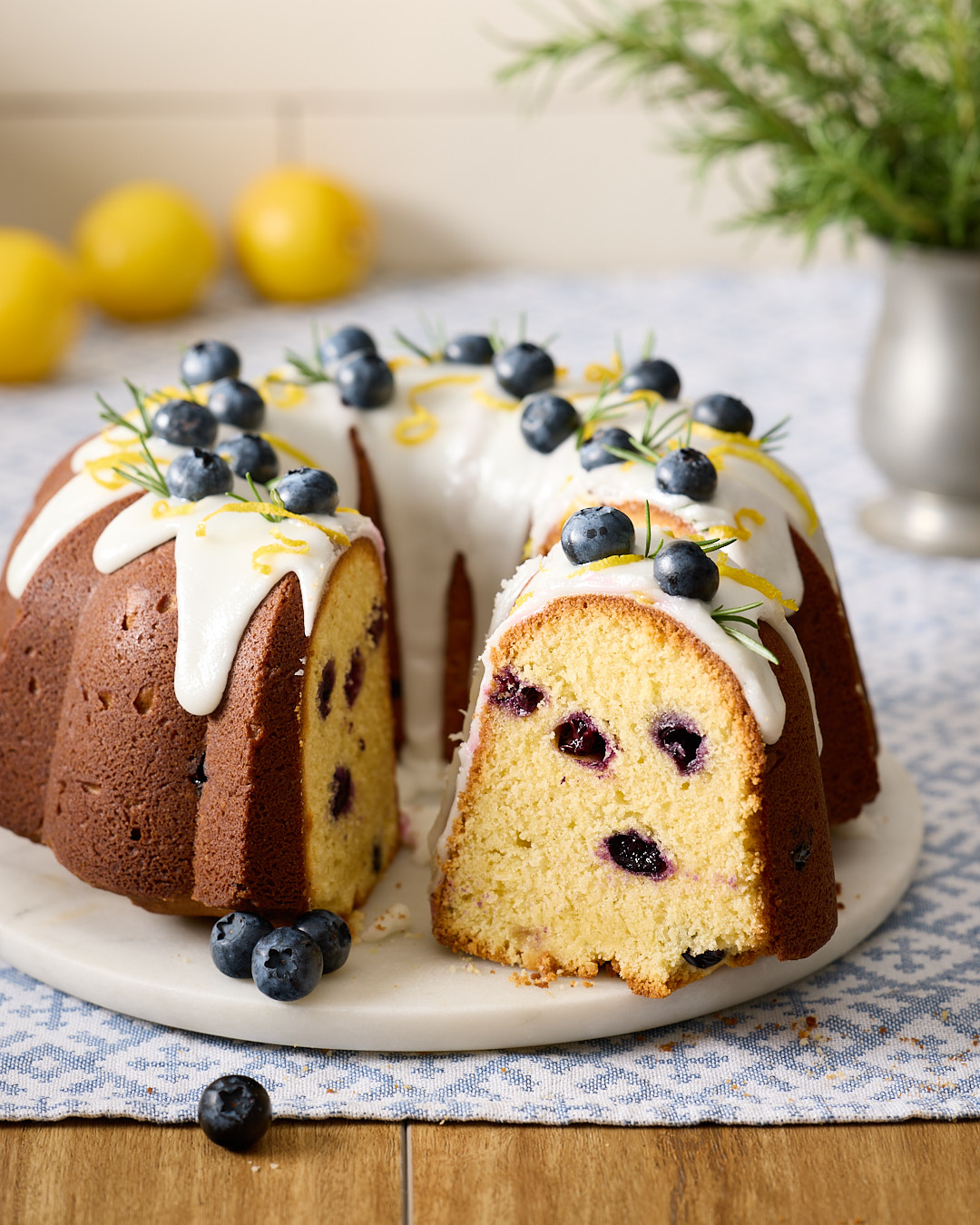
Lemon blueberry rosemary bundt cake with white lemon glaze, decorated with fresh blueberries, lemon zest, and rosemary sprigs, sliced to show moist crumb.

I’m a huge fan of the Bundt. And yes, I know the recipe name “Bundt cake” is technically a tautology. But I’m not about to risk the wrath of the Internet’s SEO godsjust in case some cake fans haven’t yet discovered the joy of a Bundt. 

If you’re new to Bundt baking, here’s the trick: start with a pound cake recipe. That dense, buttery crumb is your best insurance policy for getting the cake out of the pan in one glorious piece. I’ve always suspected the Bundt pan was invented precisely to jazz up the humble pound cake’s image. And if you’ve ever baked a lemon blueberry bundt cake, you’ll know just how perfectly that style of batter suits the pan. 

This lemon blueberry rosemary bundt cake is my modern pound cake recipe. Fresh rosemary in the batter brings an almost undetectable savoury note, adding aromatic complexity and softening the sugar hit. The result? Bright with lemon, dotted with blueberries, and just that little bit more sophisticated—yet still an easy lemon blueberry bundt cake. 

It’s a modern bake that tips its hat to the origins of the pound cakethough I can’t promise the classic pound-for-pound ratio of sugar, butter, eggs, and flour. And don’t stress if you don’t have a large 10-cup (2.5 litre) Bundt panyou can always divide the batter between two large loaf pans. 

Ingredients

Bundt ingredients

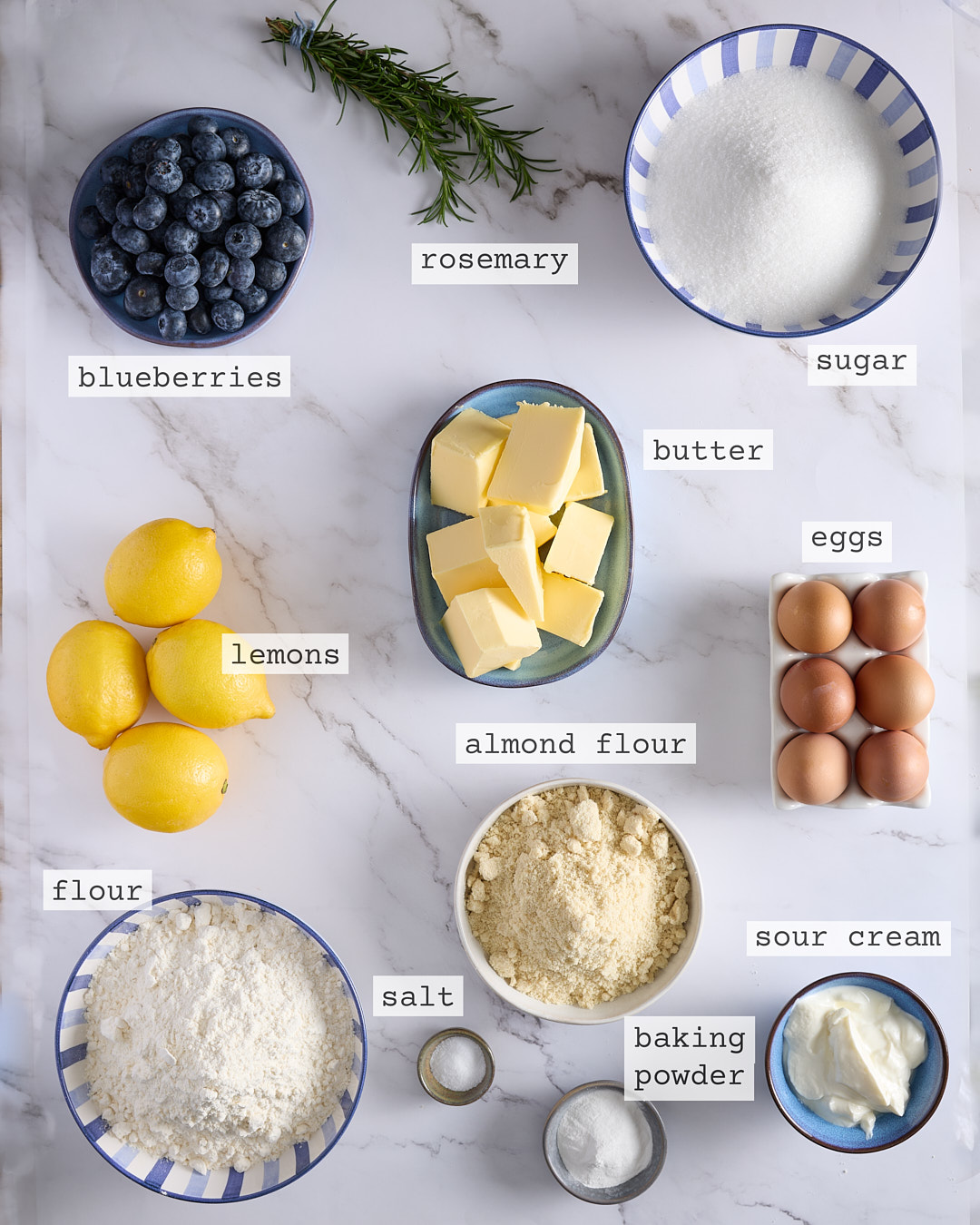
Flat lay of ingredients for lemon blueberry rosemary bundt cake showing lemons, blueberries, rosemary, butter, sugar, eggs, almond flour, sour cream, flour, salt, and baking powder.
  • 4 tablespoons lemon zest 
  • 4-6 sprigs fresh rosemary 
  • ¾ teaspoon salt 
  • 380g unsalted butter 
  • 135g almond flour
  • 100g full fat Greek yoghurt
  • 140g egg yolks
  • 140g whole eggs 
  • 520g cake flour 
  • 2 ½ teaspoons baking powder 
  • 80g lemon juice 
  • 150g fresh blueberries

I’ve strayed from the traditional pound cake ratios to create a moist, tender crumb while also pushing up the richness of the cake. But I’ve kept the additions minimal to stay within the bounds of an easy lemon blueberry bundt cake. 

The full-fat yoghurt is here unapologeticallyits tang hasn’t been neutralised with baking soda. Isn’t the tang the point? It boosts the cake’s flavour while adding moisture without making the batter too loose. Extra richness comes from favouring yolks over whole eggs, and a measure of almond flour helps lock in that tender crumb. 

As for the lemons, roughly four medium ones will yield about four tablespoons of zest. But honestly, can you ever have too much zest in a lemon blueberry bundt cake? And when it comes to the yolk-to-egg ratio, don’t get too hung up on an exact 140g yolks/140g whole eggs split. The split can be slightly offI land pretty close using 6 large eggs, and if you’re short on yolks, just add a bit of white. 

Lemon royal icing ingredients

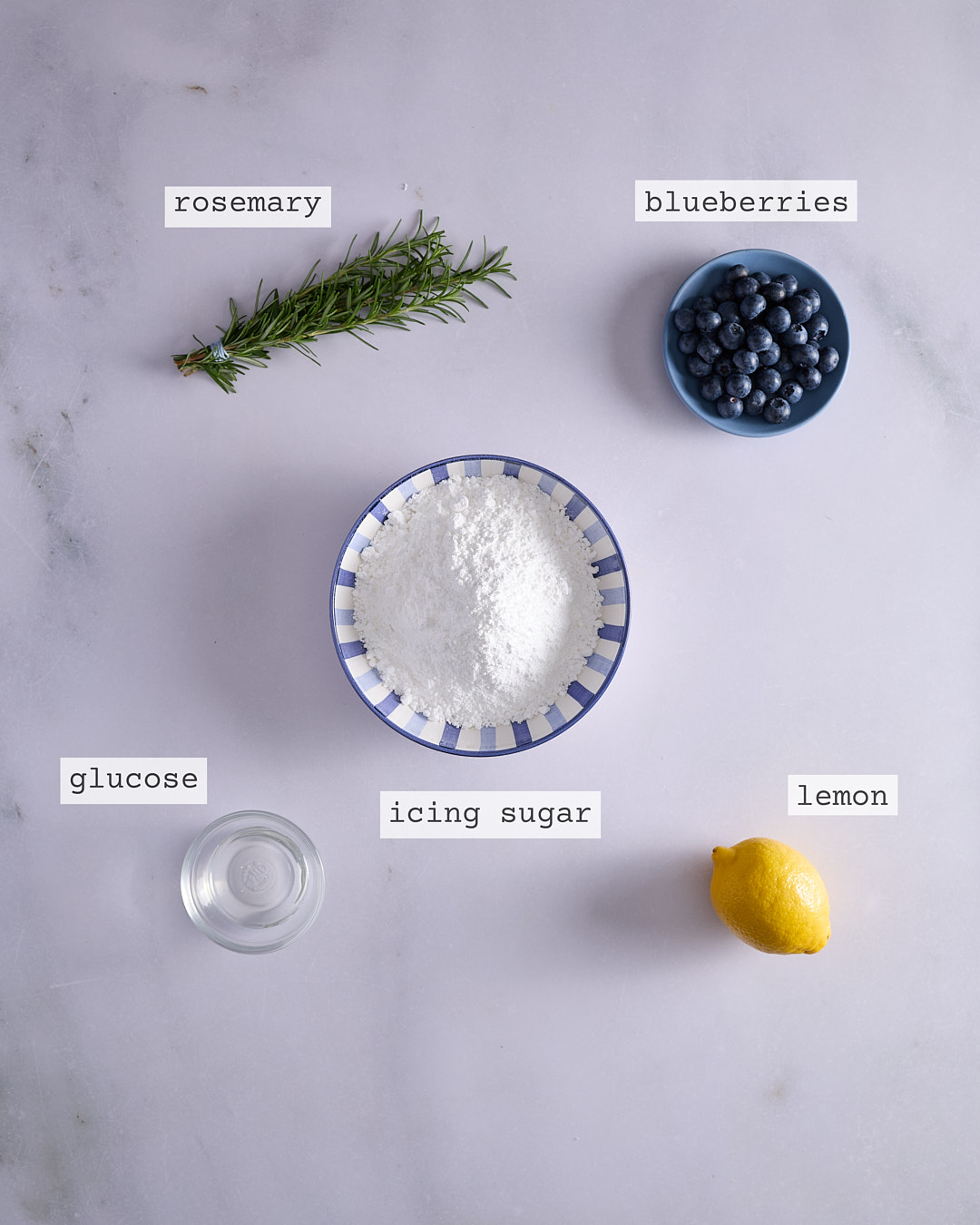
Overhead of icing ingredients for lemon blueberry rosemary bundt cake including rosemary, blueberries, icing sugar, lemon, glucose, and granulated sugar.
  • 250g pure icing sugar 
  • 4 teaspoons lemon juice 
  • 4 teaspoons glucose syrup 
  • 60g fresh blueberries 
  • 1 sprig fresh rosemary 
  • 200g granulated white sugar 

For the royal icing, I’ve kept things simple. The icing sugar forms the base, lemon juice (handily, from all those zested lemons) brings brightness, and a touch of glucose syrup keeps the finish smooth and glossy. Blueberries and rosemary are optional, but I like the decoration to reflect what’s already in the cakeit lets the cake tell its own story. 

The granulated sugar is included solely for making candied lemon zesta sharp, sweet garnish that doubles as decoration. You’ll find the method in the notes if you want to include it, though just microplaning a little fresh zest over the top is perfectly fine.

'Mise en place'

I’m an adherent to the French cooking method of mise en placeeverything in its place. Getting all your equipment and ingredients out before baking begins really does put the ‘easy’ into this easy lemon blueberry bundt cake recipe. If I’m not weighing something directly into the mixing bowl, I portion it into a separate bowl, ready to go when needed. Yes, it means a few more dishes at the end, but I’ll happily wash up later if it saves me the stress of scrambling mid-bake. 

Room temperature—plan ahead

The key to a smooth cake batter is starting with ingredients at room temperature. Cold butter and eggs are a fast track to a split batter, and that can impact the quality of the final bake. I take the butter and eggs out the night before. If I forget, I put the weighed-out butter in a warm ovenno higher than 30°Cfor a few minutes. Set a timer: melted butter won’t save you. Eggs can be brought to room temp quickly by placing them (shell on) in a bowl and pouring hot water over them; they’ll be ready in a few minutes. 

Preheat the oven

Once your ingredients are ready, preheat the oven to 155°C fan or 175°C conventional. Bundt cakes bake low and steady—too much heat too quickly and the crust will set before the centre has a chance to rise. 

Be finicky about prepping the Bundt pan

For this lemon blueberry bundt cake recipe, the prep work mattersdon’t rush the job of greasing the pan only to face tears when the cake refuses to release. My next step after turning on the oven is always preparing the Bundt pan. 

I use the Nordicware Bundt Anniversary Pan, with a 10–15 cup (2.4–3.5 litre) capacity. This batter is around 2.5 litres, and being a pound-cake base, it doesn’t rise dramatically.  

The easiest way to prepare a Bundt pan is with a spray oil that has flour already added. In Australia, Bakels Sprink Release Agent is the go-to (mainly available in cake supply stores). In the US, PAM with flour does the job. Hold the can 20–30cm away, spray two light coats, and then use a pastry brush to work the oil into every crevice with upward strokes. Turn the pan upside down on the bench to let any excess drain.  

Alternatively, brush the pan with a thin layer of flavourless vegetable oil and use a fine sieve to dust it with flour. Tap out the excess by turning the pan upside down on the bench. 

If you’re baking this modern pound cake recipe in loaf pans instead, choose larger bread-sized loaf tins rather than smaller cake pans. Each needs to hold about 1.25L of batter; mine measure 12cm x 22cm x 7cm. 

Make the cake batter

Start with the sugar

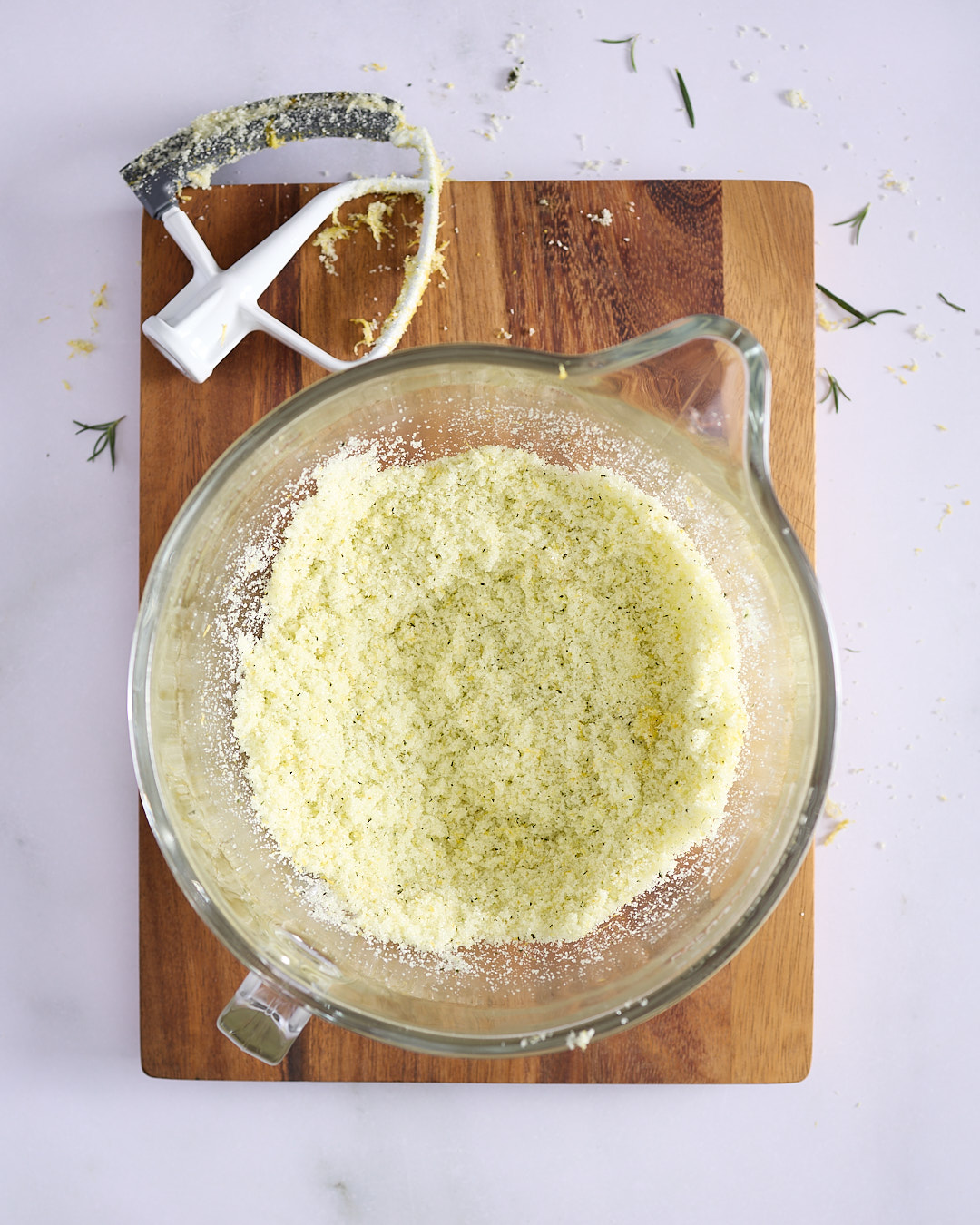
Glass stand mixer bowl filled with granulated sugar mixed with lemon zest and rosemary, paddle attachment resting nearby —before creaming in a lemon blueberry rosemary bundt cake.

This is a lemon blueberry rosemary Bundt cake. The blueberries will play their fruity role by adding those vibrant purple jammy pops, while the lemon zest and fresh rosemary may seem like supporting acts, but they’re actually the most important ingredients in this modern pound cake recipe. 

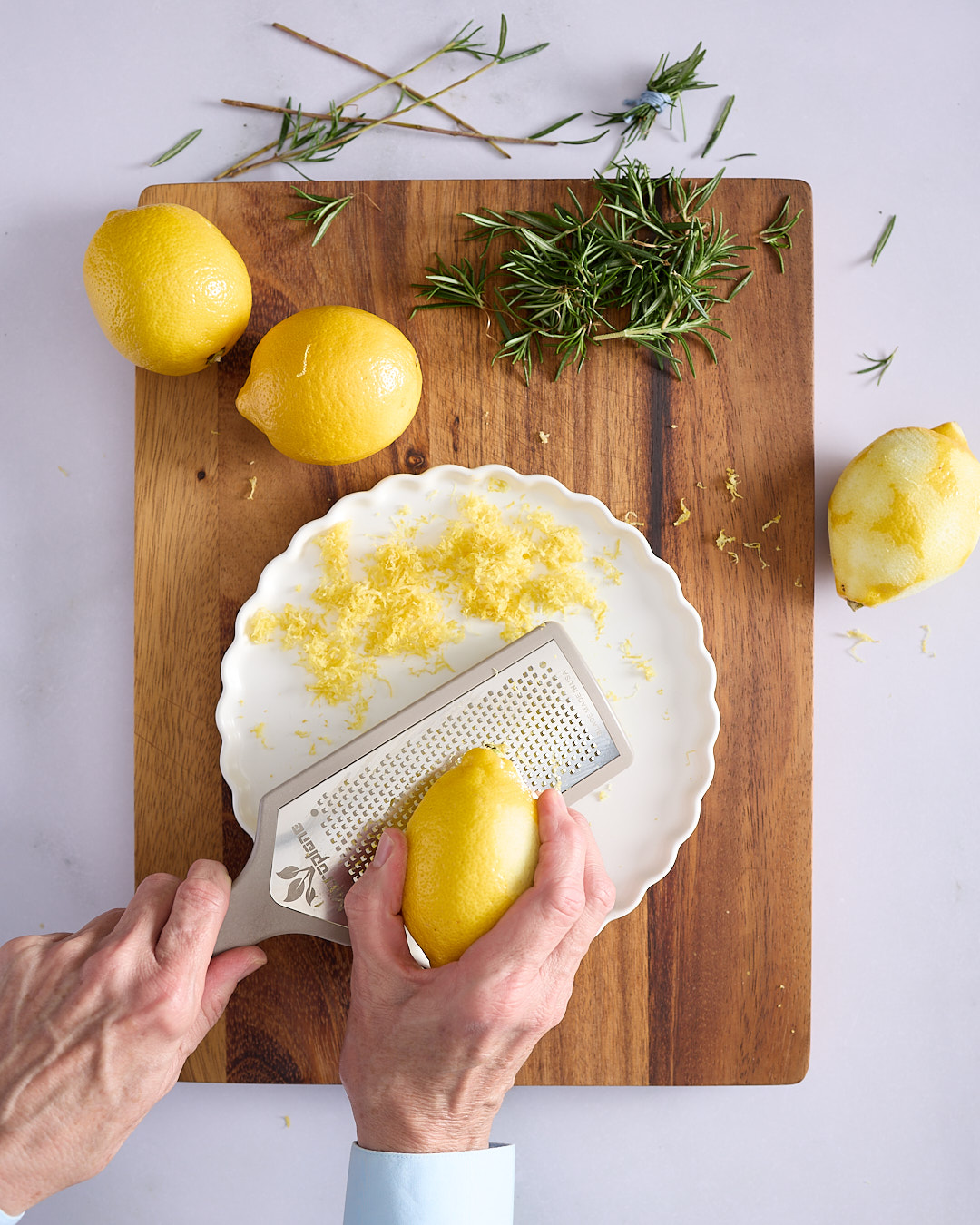
Sandra zesting a lemon with a Microplane over a white plate, with fresh rosemary sprigs and whole lemons on a wooden board—step showing preparation of zest and herbs for a lemon blueberry rosemary bundt cake.

I use a fine Microplane to zest 4 lemons, which should yield about 2 tablespoons lemon zest. You’ll also need 2 tablespoons finely chopped fresh rosemary. I grow my own, so I can cut only the freshest tips of the stems, avoiding the older woodier parts. If you’re buying rosemary, look for lighter, moister stemsthey stay greener and soften more readily during baking. Strip the leaves carefully from the stems and discard the woody parts. I usually blitz the leaves in a spice grinder so the rosemary appears only as flecks in the cake, but you can achieve the same result with fine knife work. 

Aroma is flavour

Flavour is largely built on aroma, and the aroma of lemon and rosemary comes from the oils locked inside. Recipes often call for bruising herbs to release their oils, but in baking, friction is your best tool. Beating the lemon zest, rosemary, and 380g granulated white sugar together releases their oils, distributing that flavour and aroma through the sugar, which then carries it evenly throughout the batter. 

Using a stand mixer with a flat paddle attachment, I beat the sugar, lemon zest, and rosemary for 3–4 minutes, starting on low and increasing to medium. Handheld electric beaters will work too. Once the sugar is perfumed with citrus and herb, it’s time to bring in the butter. 

Complete the batter

To complete the lemon blueberry bundt cake batter, add 380g softened unsalted butter and ¾ teaspoon salt to the sugar mixture and beat on medium in the stand mixer until the butter becomes pale yellow and the mixture looks fluffy (about 3–4 minutes). 

Sift 135g almond flour through a coarse sieve to remove any lumps, add to the stand mixer bowl, and beat on medium until incorporated. 

In a 1 litre pouring jug, whisk together the 140g egg yolks, 140g whole eggs, and 100g full-fat yoghurt. Add this mixture in batches to the stand mixer bowl, beating on medium between each addition until fully incorporated. 

Sift 520g cake flour and 2 ½ teaspoons baking powder together in a separate medium bowl. Add in three batches to the batter, beating on low each time until just combined. Overbeating at this stage will develop the gluten in the flour and lead to a tighter, tougher crumb. 

Finally, add 80g freshly squeezed lemon juice to the batter and beat on medium for no more than 30 seconds. This incorporates the juice and ensures the ingredients are evenly blended without overworking the mixture. 

Filling the Bundt pan

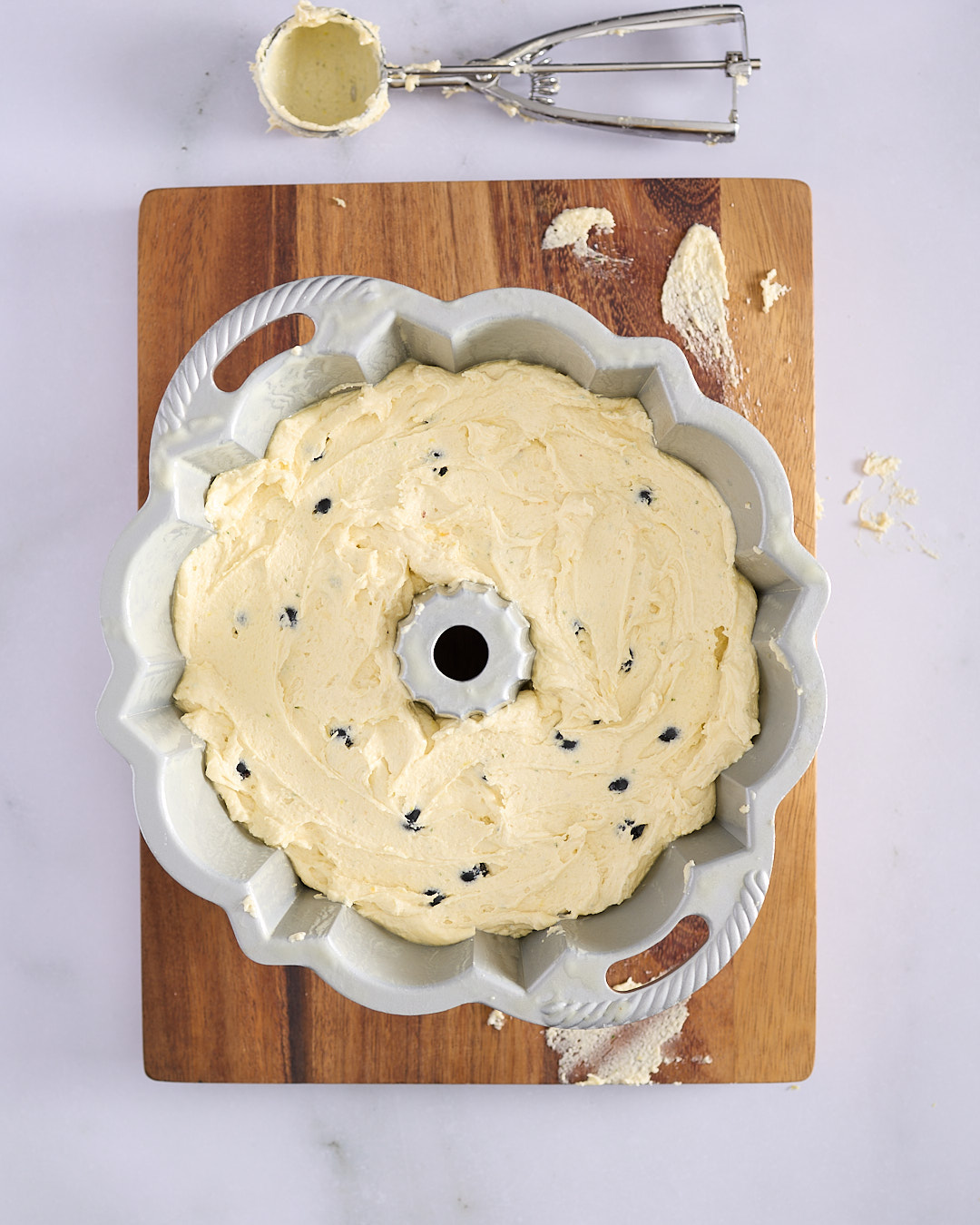
Bundt pan filled with pound cake batter dotted with fresh blueberries, smoothed with an offset spatula; ice cream scoop resting nearby on a wooden board—step showing how to layer and fill batter for a lemon blueberry rosemary bundt cake.

This easy lemon blueberry bundt cake recipe calls for 150g fresh blueberries. Using frozen blueberries will result in the berries bleeding much more of their purple juice into the batter. Fresh blueberries hold their shape better and keep the cake crumb a deep golden yellow with just a few pops of jammy purple. To help keep them in place, I sift a little flour over the berries and toss them through it before folding them into the batter. 

The pound cake batter is quite stiff and can hold a good number of blueberries without them all sinking to the bottom of the Bundt pan during the bake. Feel free to add a few extra berries—just try to distribute them evenly rather than clumping them together. 

One extra tip: avoid letting blueberries sit directly on the bottom or right up against the sides of the Bundt pan. This helps prevent the fruit from sticking and risking a tear when releasing the baked lemon blueberry bundt cake. 

I use an ice cream scoop to transfer the batter into the pan and an offset spatula to smooth it out as I go. After each layer of batter, I give the pan a gentle tap on the bench to release any air pockets, then scatter a few blueberries before continuing with the next layer. I finish with more blueberries on top of the batter, pressing them in lightly and covering them with the spatula. 

The batter should finish at least 2cm below the rim of the pan. 

Baking and releasing

Baking the lemon blueberry bundt cake

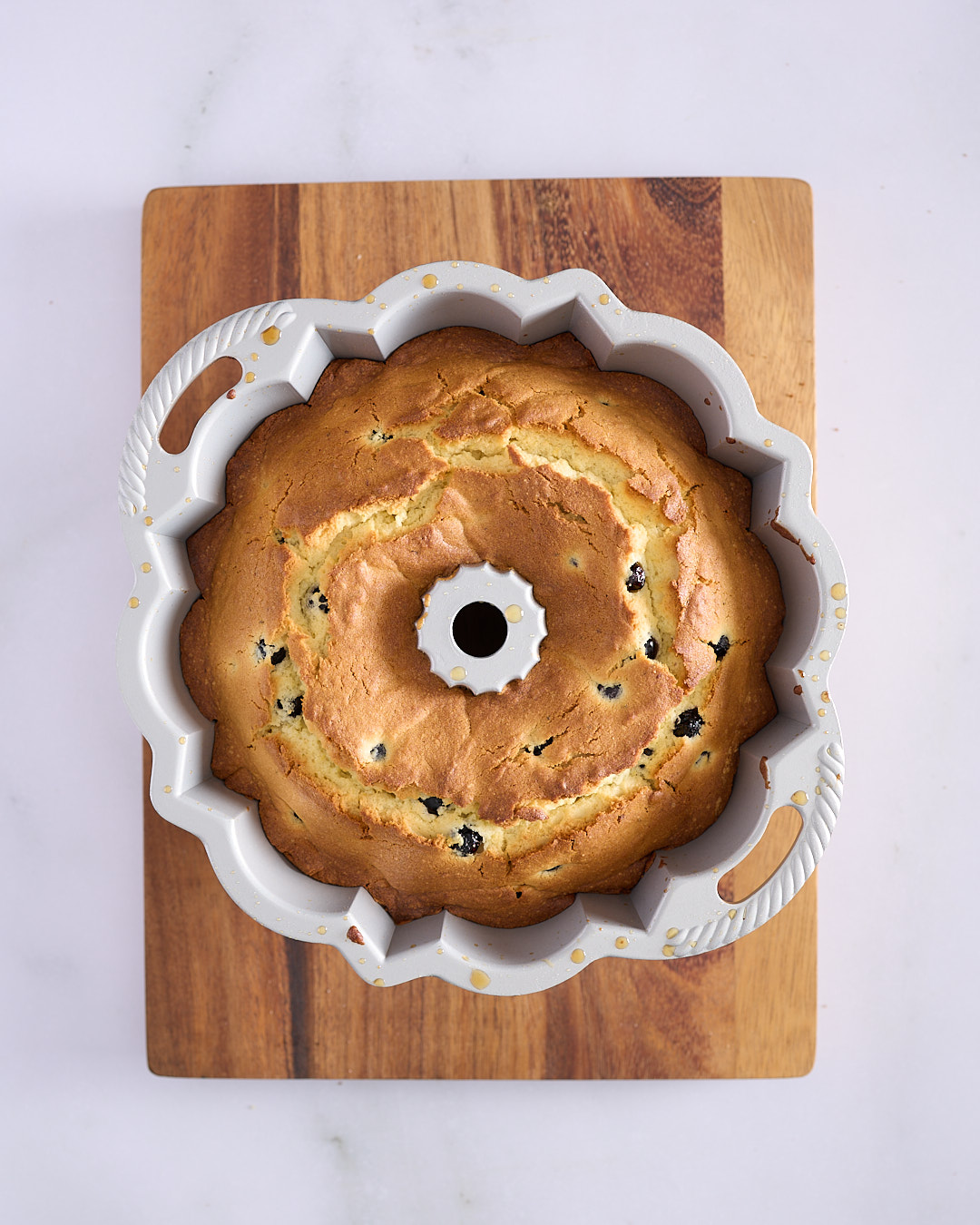
Baked lemon blueberry bundt cake still in its pan, golden brown with blueberries visible, resting on a wooden board after coming out of the oven.

Bake the easy lemon blueberry bundt cake at 155°C fan or 175°C conventional for 60–65 minutes. Start testing the cake from about 55 minutes, as every oven runs differently. Insert a cake tester or long skewer into the deepest part of the cake; it’s done when the skewer comes out with only a few moist crumbs clinging to it. Because Bundt cakes are deep, I recommend testing three different spots. If you have an instant-read thermometer, the cake is ready at 95°C. 

Releasing the lemon blueberry bundt cake

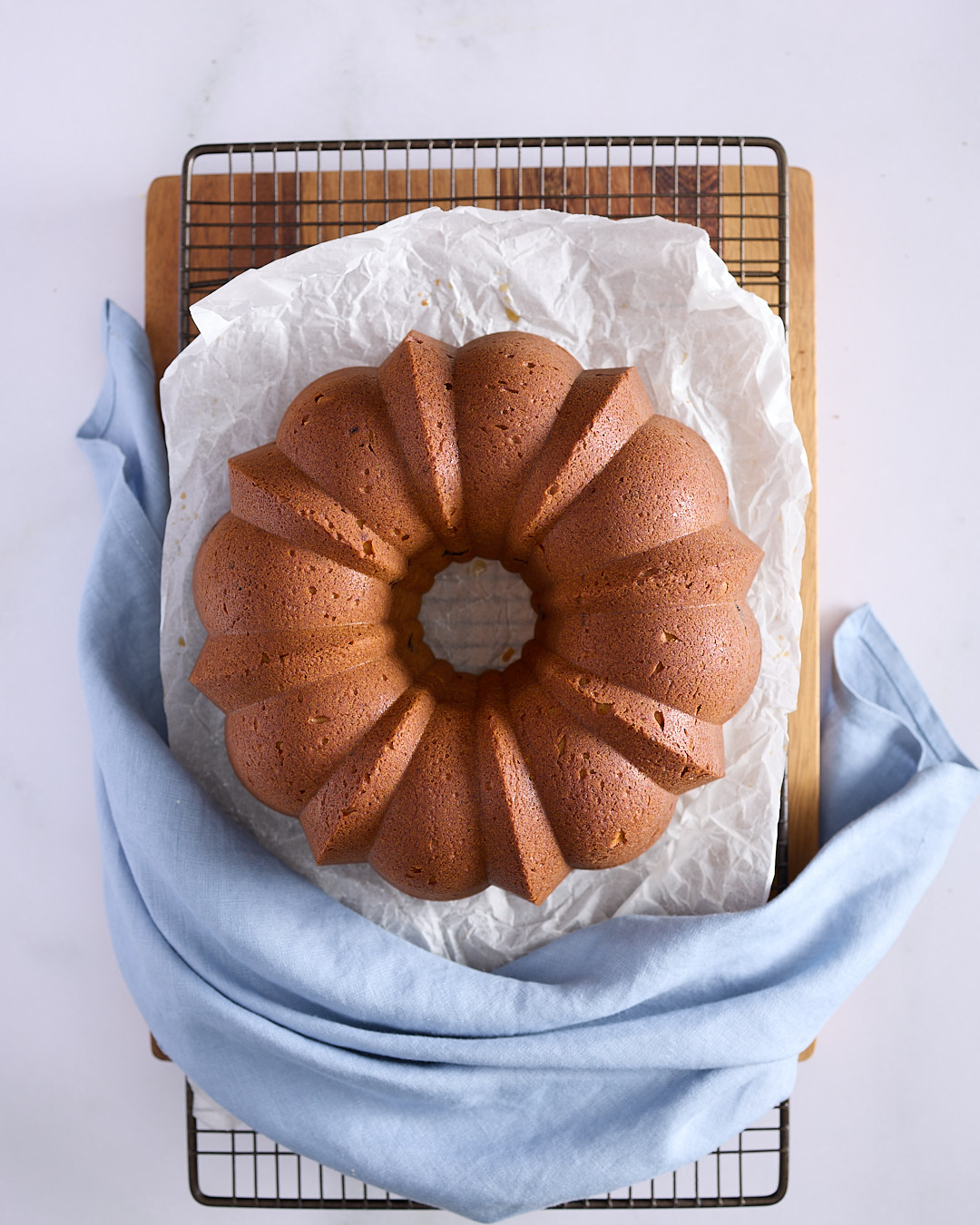
Lemon blueberry bundt cake released from its pan, cooling upside down on a wire rack lined with baking paper, draped with a blue napkin.

Cool the Bundt in its pan on a cake rack for 10–20 minutes. Don’t leave it in the pan to fully cool—it needs to be released while still warm to avoid sticking. 

Place a piece of baking paper over the Bundt, then set the cake rack on top. Holding everything firmly, invert the pan and rack together onto the bench. Gently lift the pan to see if the cake has released. 

If it hasn’t, don’t panic. Turn it back upright and use either a small offset spatula or your fingers to gently loosen the edges around the pan sides and the centre ring. Try inverting again. If it still resists, let gravity do the work by leaving it a few more minutes. As a last resort, hold the pan and cake rack together and give them a firm tap on the bench. Just note this can result in the stuck portion tearing away. 

Bundts do take a little practice, but mostly it’s patience and keeping your expectations realistic. And remember—even if your lemon blueberry bundt cake comes out missing a few chunks—all sorts of sins can be hidden with a good layer of icing and some well-placed décor. 

Glazing and decorating

Candied lemon peel

If you’re making the candied lemon peel, the method is included in the notes. It adds a sharp-sweet element and brings colour and texture to the finished Bundt, but it’s optional. Just microplaning a little fresh zest over the top works too. 

Making the lemon royal icing

Glazing or icing a Bundt cake is all about viscosity—yet again science encroaches on baking. How you want the glaze to spread (or not spread) down the sides of the Bundt is a matter of personal taste and how you want to present the cake. I often prefer a thin glaze that covers the whole surface, letting the colour of the cake show through. 

For this easy lemon blueberry Bundt cake, I wanted more control, with drips just starting to make their way down the sides. This way the golden crust of the pound cake is still the hero. The glucose syrup helps control the viscosity of the royal icing—lemon juice alone can quickly tip icing into a runny glaze. The glucose syrup also stops the royal icing from completely going hard—it will have a firm crust but be soft underneath.   

To make the lemon royal icing, sift 250g pure icing sugar into the bowl of the stand mixer. Add 2 teaspoons lemon juice and 4 teaspoons glucose syrup. A trick with syrup: lightly spray the measuring spoon with vegetable oil before scooping, then drizzle into the spoon—it stops the jar getting sticky. 

Mix on low to medium-low with the paddle attachment until a smooth paste forms. Then drip in the remaining lemon juice a little at a time until you reach your desired viscosity. Test it by dripping some onto the top of an upside-down bowl to see how it flows. If you’ve taken it too far, add more sifted icing sugar until it thickens again. 

Decorating the lemon blueberry rosemary bundt cake

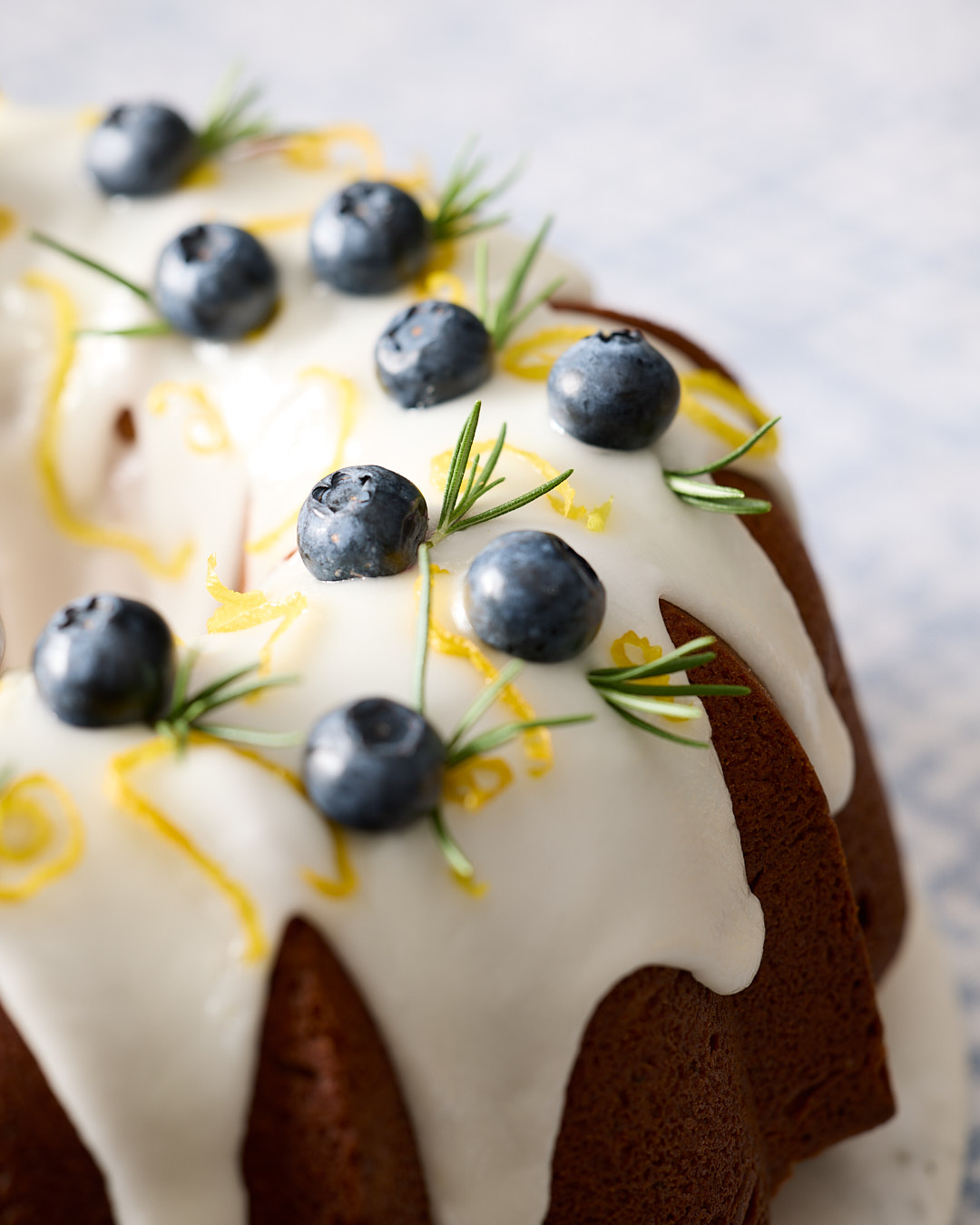
Once the cake has cooled completely, spoon or pipe the royal icing over the top, letting it drip just enough to frame the ridges without covering the crust entirely. 

For decoration, I scatter 60g fresh blueberries over the top, tuck in sprigs from 1 fresh rosemary stem, and add strips of candied lemon peel for sharpness and colour. The idea is to echo the flavours already inside the cake—blueberries, rosemary, and lemon zest—so the outside this modern pound cake tells the same story as the cake within. 

Close-up of a Bundt cake’s surface—glazed top dripping slightly, dotted with blueberries and sprigs of rosemary, lemon zest curling over the edge.

“As for rosemary, I let it run all over my garden walls … it is the herb sacred to remembrance and to friendship.” – often attributed to Sir Thomas More (1478–1535)

In this cake, the herb isn’t a garnish—it’s the quiet hand on the tiller. Rosemary’s piney, savoury edge reins in sweetness and gives lemon and blueberry something to push against.  

That’s the promise of my lemon blueberry rosemary Bundt cake as a modern pound cake—bright citrus, jammy berries, and a subtle herbal note that lingers. Nothing shouty, nothing complicated; just a familiar favourite taken one thoughtful step forward. 

Lemon Blueberry Rosemary Bundt Cake

Lemon blueberry rosemary bundt cake with white lemon glaze, decorated with fresh blueberries, lemon zest, and rosemary sprigs, sliced to show moist crumb.
This lemon blueberry rosemary bundt cake is my modern pound cake recipe. Fresh rosemary in the batter brings an almost undetectable savoury note, adding aromatic complexity and softening the sugar hit. The result? Bright with lemon, dotted with blueberries, and just that little bit more sophisticated—yet still an easy lemon blueberry bundt cake.
Prep Time 1 hour
Cook Time 1 hour 5 minutes
Course Cake, Dessert
Cuisine American, European, German
Servings 8 -10 people

Equipment

  • Bundt pan (10-cup / 2.5-litre capacity)
  • Digital scales
  • Stand mixer with flat paddle attachment (or handheld electric beaters)
  • 1 litre pouring jug
  • Coarse sieve
  • fine sieve
  • Microplane
  • Spice grinder (optional)
  • Pastry brush
  • Offset spatula (optional)
  • Ice cream scoop (optional)
  • Cake tester or long skewer
  • Instant read thermometer (optional)
  • cooling rack

Ingredients  

Bundt cake:

  • 4 tablespoons lemon zest
  • 4-6 sprigs fresh rosemary
  • ¾ teaspoon salt
  • 380 g unsalted butter
  • 135 g almond flour
  • 100 g full fat Greek yoghurt
  • 140 g egg yolks
  • 140 g whole eggs
  • 520 g cake flour
  • 2 ½ teaspoons baking powder
  • 80 g lemon juice
  • 150 g fresh blueberries

Lemon royal icing and décor:

  • 250 g pure icing sugar
  • 4 teaspoons lemon juice
  • 4 teaspoons glucose syrup
  • 60 g fresh blueberries
  • 1 sprig fresh rosemary
  • 200 g granulated white sugar (optional)

Instructions 

Get organised:

  • Prepare all equipment and ingredients before starting.
  • Bring butter, eggs and yoghurt to room temperature before baking.
  • Weigh each ingredient and portion into separate bowls if not being added directly to the mixing bowl.
  • Preheat the oven: Preheat the oven to 155°C fan or 175°C conventional.

Prepare the Bundt pan:

  • Grease a 10-cup (2.5-litre) Bundt pan with a spray oil containing flour and use a pastry brush to spread the oil evenly into all crevices.
  • Invert the pan to drain excess.
  • Alternatively, brush lightly with vegetable oil, dust with sifted flour, and tap out any excess.

Start with the sugar:

  • Zest 4 lemons (about 2 tablespoons zest) and finely chop 2 tablespoons fresh rosemary.
  • Combine the lemon zest and rosemary with 380g granulated white sugar in the bowl of a stand mixer.
  • Beat with the flat paddle attachment on medium speed for 3–4 minutes.

Complete the batter:

  • Add 380g softened unsalted butter and ¾ teaspoon salt to the sugar mixture.
  • Beat on medium speed for 3–4 minutes until pale and fluffy.
  • Sift in 135g almond flour through a coarse sieve and beat in until incorporated.
  • In a 1-litre pouring jug, whisk 140g egg yolks, 140g whole eggs, and 100g full-fat yoghurt. Add the egg mixture in batches to the stand mixer, beating on medium between each addition until combined.
  • Sift 520g cake flour and 2½ teaspoons baking powder in a separate bowl. Add to the batter in three batches, beating on low until just combined each time.
  • Add 80g freshly squeezed lemon juice and beat on medium for up to 30 seconds batter is smooth.

Filling the Bundt pan:

  • Toss 150g fresh blueberries in a little flour.
  • Layer the batter into the prepared Bundt pan using an ice cream scoop. Smooth each layer with an offset spatula, tapping the pan gently on the bench to remove air pockets.
  • Scatter blueberries evenly between layers—avoiding the blueberries making contact with the sides of the pan.
  • Press the final blueberries lightly into the top of the batter.
  • The batter should finish about 2cm below the rim of the pan.

Baking the Bundt cake:

  • Bake for 60–65 minutes at 155°C fan (175°C conventional).
  • Begin testing at 55 minutes.
  • The cake is done when a skewer inserted into the deepest part comes out with a few moist crumbs. For accuracy, test in three places.
  • If using an instant-read thermometer, the cake is ready at 95°C.

Releasing the Bundt cake:

  • Cool the Bundt in its pan on a cooling rack for 10–20 minutes.
  • Place baking paper over the top, followed by the cooling rack. Invert the pan and rack together onto the bench and lift the pan gently. If the cake sticks, loosen the edges and centre with a small offset spatula before inverting again.
  • See notes for troubleshooting.

Making the lemon royal icing:

  • Sift 250g pure icing sugar into the stand mixer bowl.
  • Add 2 teaspoons lemon juice and 4 teaspoons glucose syrup. Lightly spray the spoon with vegetable oil before measuring syrup to prevent sticking.
  • Mix on low to medium-low with the paddle attachment until a smooth paste forms.
  • Add additional lemon juice gradually until the desired viscosity is reached.
  • Test by dripping a little icing onto an inverted bowl.
  • If the icing is too thin, add more sifted icing sugar.

Decorating the Bundt:

  • Once the cake is completely cool, spoon the icing over the top, allowing it to drip down the sides. Decorate with 60g fresh blueberries, 1 sprig fresh rosemary, and candied lemon peel.

Just before you cook with abandon…

Room temperature: When making cake, all ingredients should be at room temperature to prevent the batter from splitting and to ensure an even texture. I get the butter, eggs, and yoghurt out the night before. If I forget, I warm the weighed-out butter in a low oven (no higher than 30°C) for a few minutes—set a timer to avoid melting. Eggs (shell on) can be placed in a bowl and covered with hot water to bring to room temperature quickly.
Avoiding blueberries touching the pan:  Keep the blueberries from touching the sides or base of the Bundt pan. Direct contact can cause the fruit to stick and tear the cake during release. Tossing the berries lightly in flour before adding them to the batter helps prevent them from sinking. 
Bundt release troubleshooting: If the Bundt doesn’t release easily after cooling it in the pan for 10–20 minutes, loosen the external and internal edges gently with a small offset spatula. Invert again and let gravity do its work. As a last resort, hold the pan and rack together and give them a firm tap on the bench. Missing chunks can always be disguised with a bit of creative icing and décor.
Wash before prepping: Herbs and non-peelable fruits should be washed in cold water and dried thoroughly before use. I use a salad spinner for herbs, then roll them between paper towels to remove any remaining moisture.
Eggs: Large eggs weigh about 52g each in the shell. For this recipe, 6 large eggs will give you close to the right 140g yolk / 140g whole egg split.
Kitchen scale: A digital kitchen scale is essential for baking accuracy. Choose a reliable brand; good ones can be found for around $70.
Tablespoons – two sizes: Australia’s tablespoon measure is 20ml, while North American (and most international) ones are 15ml. I use the 15ml version in all baking recipes for precision.
Oven temperatures: Bundt cakes bake best at a steady moderate temperature. I use the fan-forced setting at 155°C (or 175°C conventional). Oven thermometers can be unreliable, so if you suspect your oven runs unevenly, use a laser temperature gun or test bake times on a simpler recipe first.
Stand mixer versus hand mixer: This batter can be made with a quality hand mixer if you don’t have a stand mixer. Follow the same speed instructions but expect slightly longer mixing times. Avoid overbeating once the flour is added to prevent a dense crumb.
Testing for doneness: Because Bundt cakes are deeper, begin testing around 55 minutes in. The cake is done when a skewer inserted into the deepest part comes out with a few moist crumbs attached. For accuracy, test in three spots. If you have a Thermapen or instant-read thermometer, the internal temperature should be 95°C.
Candied lemon zest: Use a fine handheld lemon zester to remove long, even strands of zest—aim for strips rather than short flecks. In a small saucepan, combine 200g sugar and 200ml water, then bring to a gentle simmer. Add the zest and cook for about 10–12 minutes, until translucent and glossy. Drain and spread on baking paper to cool, or toss lightly in some of the reserved sugar syrup for extra shine. These fine, glossy strands make an elegant finishing touch for the lemon blueberry rosemary Bundt cake.
Freezer friendly: This Bundt cake freezes well, either whole or sliced. Once completely cool, wrap tightly in two layers of plastic wrap and then place into a suitably sized sealed freezer-safe container if you have one. Freeze for up to 2 months. To thaw, unwrap and leave at room temperature for 4–5 hours before serving. If freezing slices, separate them with baking paper before wrapping so you can defrost individual portions as needed. Avoid freezing the decorated cake—add the icing and décor after thawing.
Keyword lemon blueberry rosemary bundt cake

Leave a Reply

Your email address will not be published. Required fields are marked *

Recipe Rating


Hi, I'm Sandra!

I live by the words of Harriet Van Horne and I will be exploring every possible way to bring Harriet’s words to life in my kitchen.

Recipes

Discover delicious featured food recipes! From quick meals to gourmet delights, Sandra offer inspiring dishes for every occasion. Explore, cook, and enjoy flavorful creations today.

You might also like..

Easy Moroccan Preserved Lemons

Smoky Chipotle BBQ Sauce

Tomato and Preserved Lemon Salad

Pumpkin ‘Kitchen Sink’ Salad

Subscribe

Subscribe to my newsletter for a chance to win a FREE APRON (drawn monthly) as well as cooking tips, recipes, offers and exclusive content.

"*" indicates required fields