A homage to my Mother's strawberry shortcake
My Strawberry Basil White Chocolate Chiffon Cake pays homage to two pillars of my childhood: my favourite packet-mix birthday cake—the Angel Food cake—and my mother’s version of a strawberry shortcake.
We ate seasonally when I was a kid in Canada in the 1970s. Summer meant an abundance of locally grown strawberries, and these were often transformed into Mom’s shortcake. She used packaged mini sponge cakes, which were essentially just a vehicle for the syrupy goodness of the macerated fresh strawberries. While she was happy to take a shortcut with the cake, my Mom absolutely drew the line at aerosol whipped cream. Ours was always freshly whipped and piled impossibly high onto the fruit-soaked sponges.
For this recipe chiffon wins out over fond memories. I’ve chosen a vanilla chiffon over an angel food cake. While my memories of Funfetti birthday cakes are fond, adult Sandra simply won’t allow me to bake a cake where sugar is the primary ingredient.
Technically, an Angel Food cake is more of a baked meringue than a sponge; it usually contains about three times more sugar than flour to keep its fat-free structure from collapsing. By choosing a chiffon, I get to keep the lightness but introduce egg yolks and vegetable oil. This allows me to dial back the sugar and create a far more balanced, tender crumb that doesn’t require a litre of milk to wash down.
I’ve filled these chiffon layers with a punchy strawberry and basil gel and frosted the lot with a velvet-smooth whipped white chocolate ganache. It’s a modern botanical take on those childhood flavours—a cake that respects the memory of Mom’s shortcake but definitely graduated from the packet-mix era.
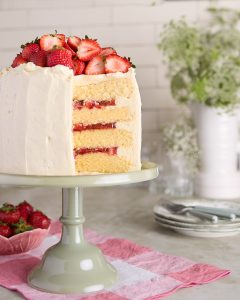
Normally at this point I would say, ‘let me break it down for you.’ But this time I need to own up to something. I really—really—wanted to get some serious height on my layer cake for the photos. But when I baked the chiffon cakes I planned to use, they were slightly less lofty than my test rounds. I was never going to get the height I wanted by splitting 2 cakes into 4 layers. So, to ensure that showstopper height in the photo, I baked another 2 cakes and used the full depth of each rather than slicing them.
Please note: baking 2 perfect chiffon cakes will not give you a four-layer cake quite as lofty as the one in the photo. You would need to bake 4 separate cakes.
Please forgive me for my vanity. And now that I’ve got that off my chest, let me break it down for you.
Ingredients
Strawberry basil gel ingredients
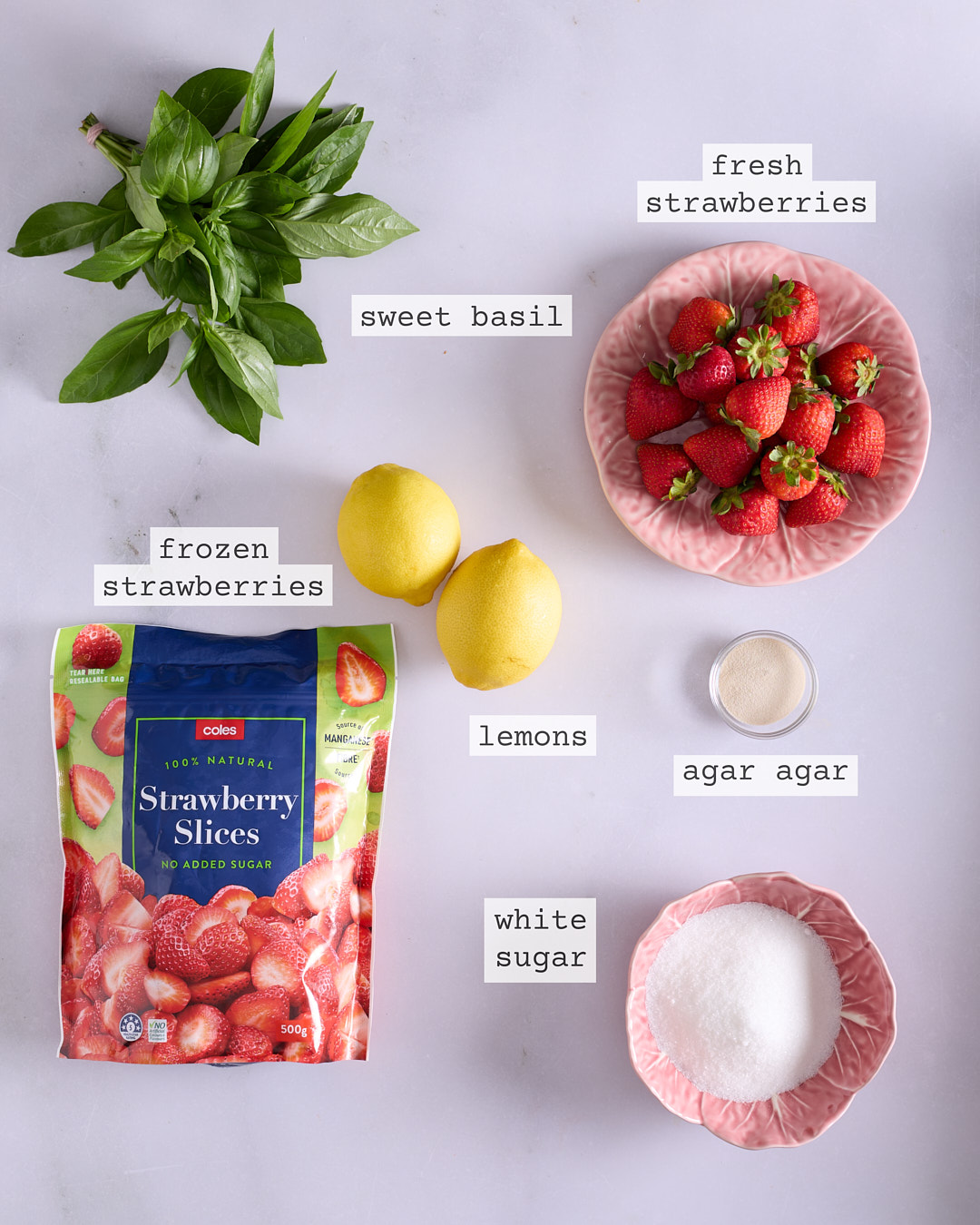
- 105g water
- 250g strawberry puree (from 500g frozen strawberries)
- 55g fresh lemon juice (approximately 2 lemons)
- 8g agar-agar
- 85g sugar
- 8g sweet basil leaves (2 small bunches basil)
- 250g fresh strawberries
The strawberry and basil gel in this botanical cake recipe uses a professional pastry technique to create what’s known as a fluid fruit gel. I’ve used agar-agar for its stability and its ability to set even when faced with acidic fruit juices or purees. The strawberry puree will set into a firm gel, which we’ll then blitz with the fresh basil into a fluid gel.
So, no, we are not making jelly and this is not a trifle recipe. Read on and all will be revealed.
Whipped white chocolate ganache ingredients
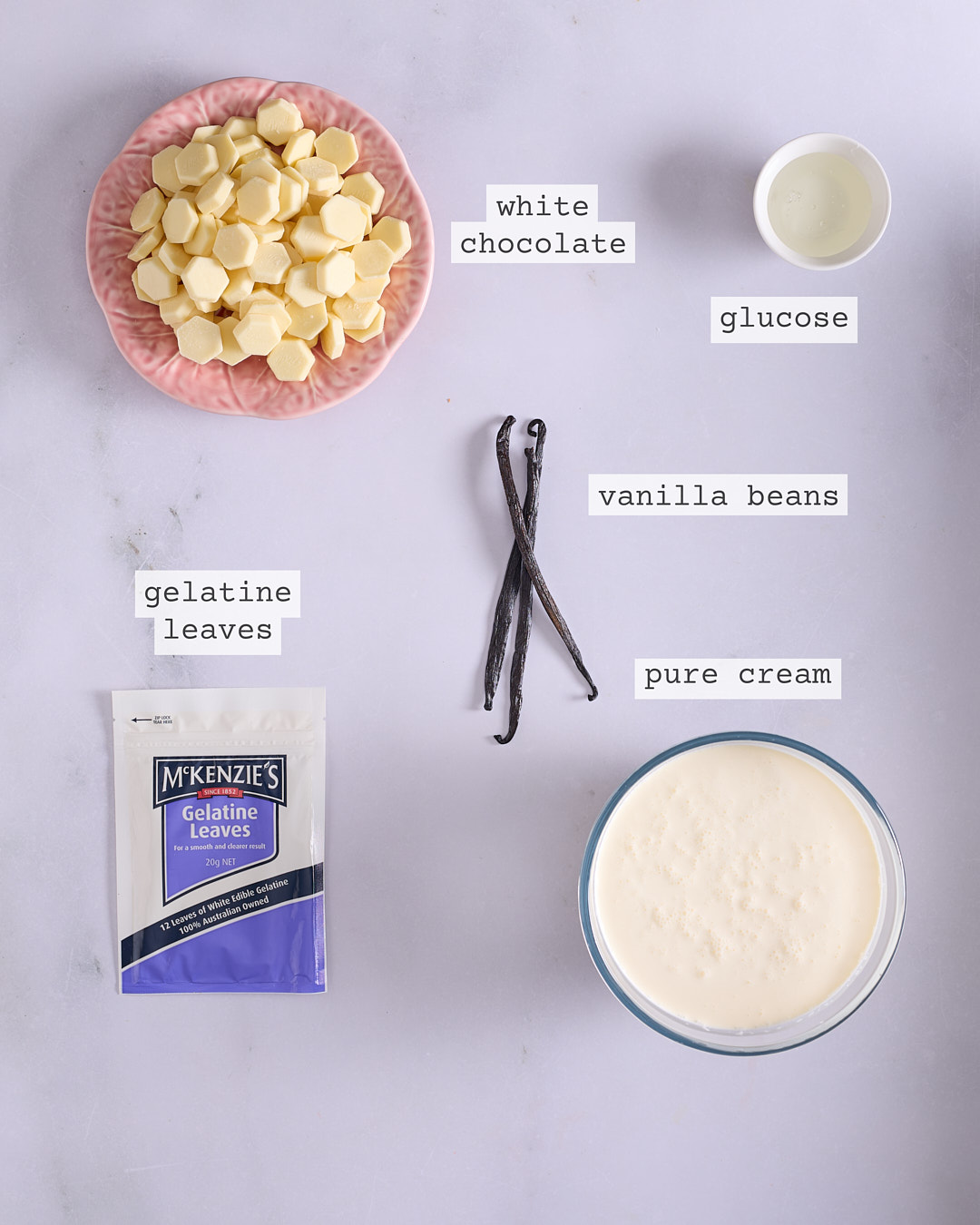
- 360g white chocolate
- 6g gelatine sheets
- 255g pure cream (A)
- 30g glucose
- 780g pure cream (B)
- 3 vanilla pods
The cream used in this recipe must be pure cream with a minimum of 35% fat content. I haven’t tested this recipe using thickened cream, and I wouldn’t recommend it if you’re looking for a stable, pipeable finish.
All white chocolate is not created equal
A successful whipped white chocolate ganache depends almost entirely on the quality of the chocolate. In the world of baking, not all white chocolate actually qualifies as ‘chocolate.’ This includes the compound varieties, melts, buttons, or chips often found in the supermarket baking aisle.
It’s the cocoa butter content that earns it the name, and that cocoa butter—along with the gelatine—is what stabilises the ganache, allowing it to hold its shape as a frosting on a tall layer cake.
As a home baker, sourcing white chocolate that actually contains cocoa butter can be a challenge. Before buying a block, check the ingredients for a minimum declaration of 23% cocoa solids. If it only lists vegetable oils, it’s not actually a bar of ‘chocolate’—move on.
For this whipped white chocolate ganache recipe, I use Lindt couverture, which sits at 36% cocoa solids and is available in many speciality markets. Cadbury’s White Baking Chocolate is a reliable supermarket option at 23% cocoa solids. If it’s in your budget and you want the professional gold standard, you can’t go past Callebaut, which ranges from 32% to 40.7% cocoa solids.
Gelatine will save the day in the summer
Gelatine plays a vital role in stabilising the frosting on this cake, especially in our humid climate. I promise it doesn’t end up with a mouthfeel like jelly—it plays a subtle supporting role to ensure your hard work doesn’t slide off the cake.
The recipe calls for 6g of gelatine sheets. I use McKenzie’s gelatine leaves because they’re consistent and readily available. For this amount, you will need four McKenzie’s leaves.
If you only have powdered gelatine on hand, you can substitute 3 teaspoons of powder bloomed in 2 tablespoons of cold water.
Vanilla chiffon cake ingredients
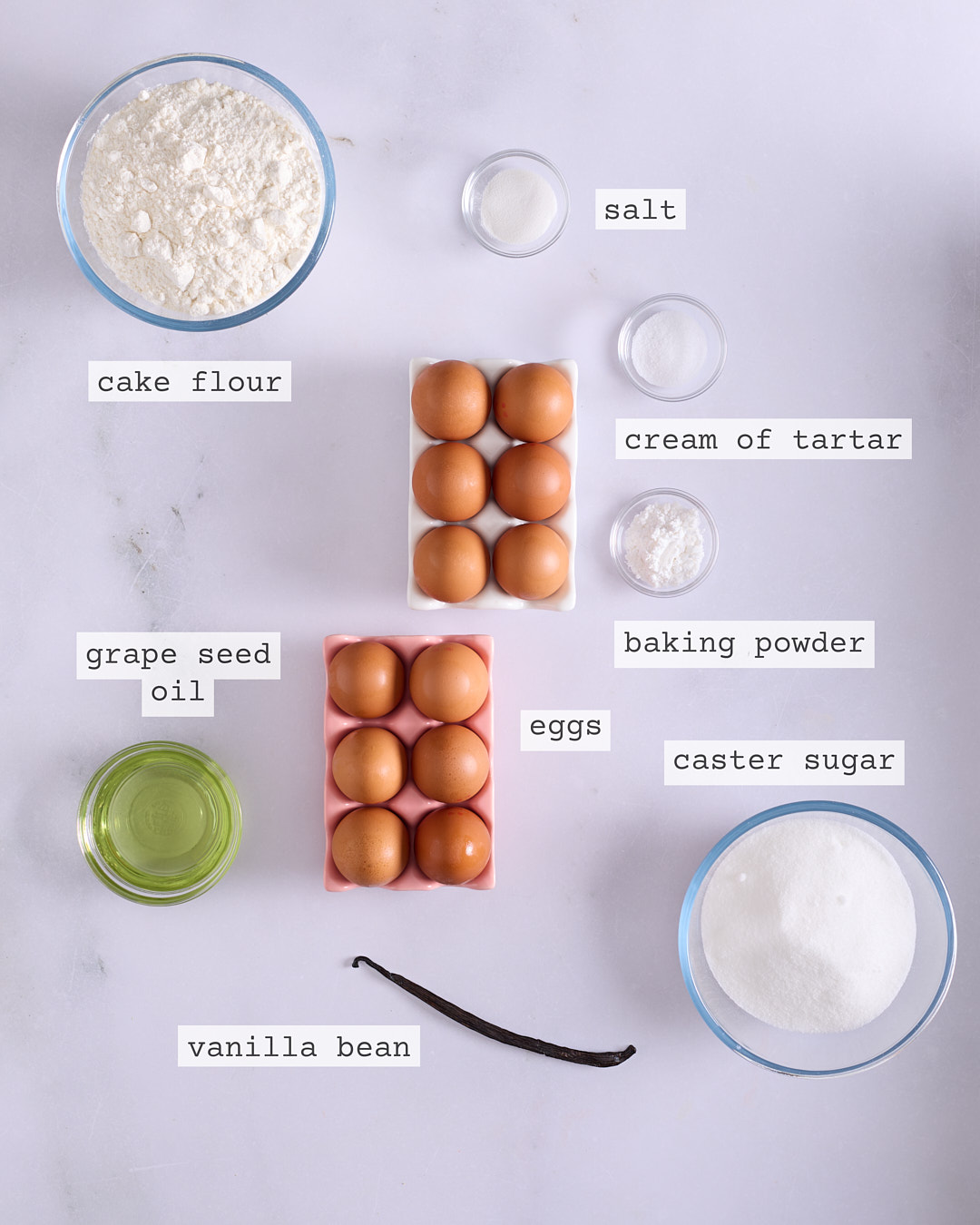
- 270g cake flour
- 95g caster sugar (A)
- ¾ teaspoon baking powder
- ¼ teaspoon salt
- 200g egg yolks
- 145g grape seed oil
- 1 vanilla bean
- 140ml just boiled water
- 175g egg whites
- 180g caster sugar (B)
- 1 ¼ teaspoon cream of tartar
Feel free to swap in 2 teaspoons of vanilla essence for the vanilla bean if you don’t have one on hand.
The egg yolks and egg whites called for in this recipe will require about one dozen large eggs to get the correct weights.
I use grapeseed oil as my flavourless oil of choice, but you can substitute canola or a plain vegetable oil.
Get organised
I’m an adherent to the French cooking principle of mise en place—everything in its place. Having your ingredients and equipment ready before you start isn’t just for professional kitchens; it’s how you keep home baking calm and consistent.
Measuring, prepping and setting everything out before the first step really does put the “easy” into any recipe.
For this botanical cake recipe, getting organised also includes starting the process a day in advance. The whipped white chocolate ganache needs to set overnight in the fridge to ensure it whips up properly. And, while the strawberry basil gel doesn’t take long to set, you might as well knock that off at the same time as the ganache.
Make ahead components
Strawberry basil gel method
Leave your 500g bag of frozen berries in the fridge the night before you want to make the strawberry basil gel. They’ll also defrost on the kitchen bench in a few hours if you haven’t planned that far ahead.
Mix 85g of sugar and 8g of agar-agar together in a small bowl and set it aside. Mixing the agar with the sugar first is the only way to ensure it incorporates smoothly without clumping once it hits the liquid.
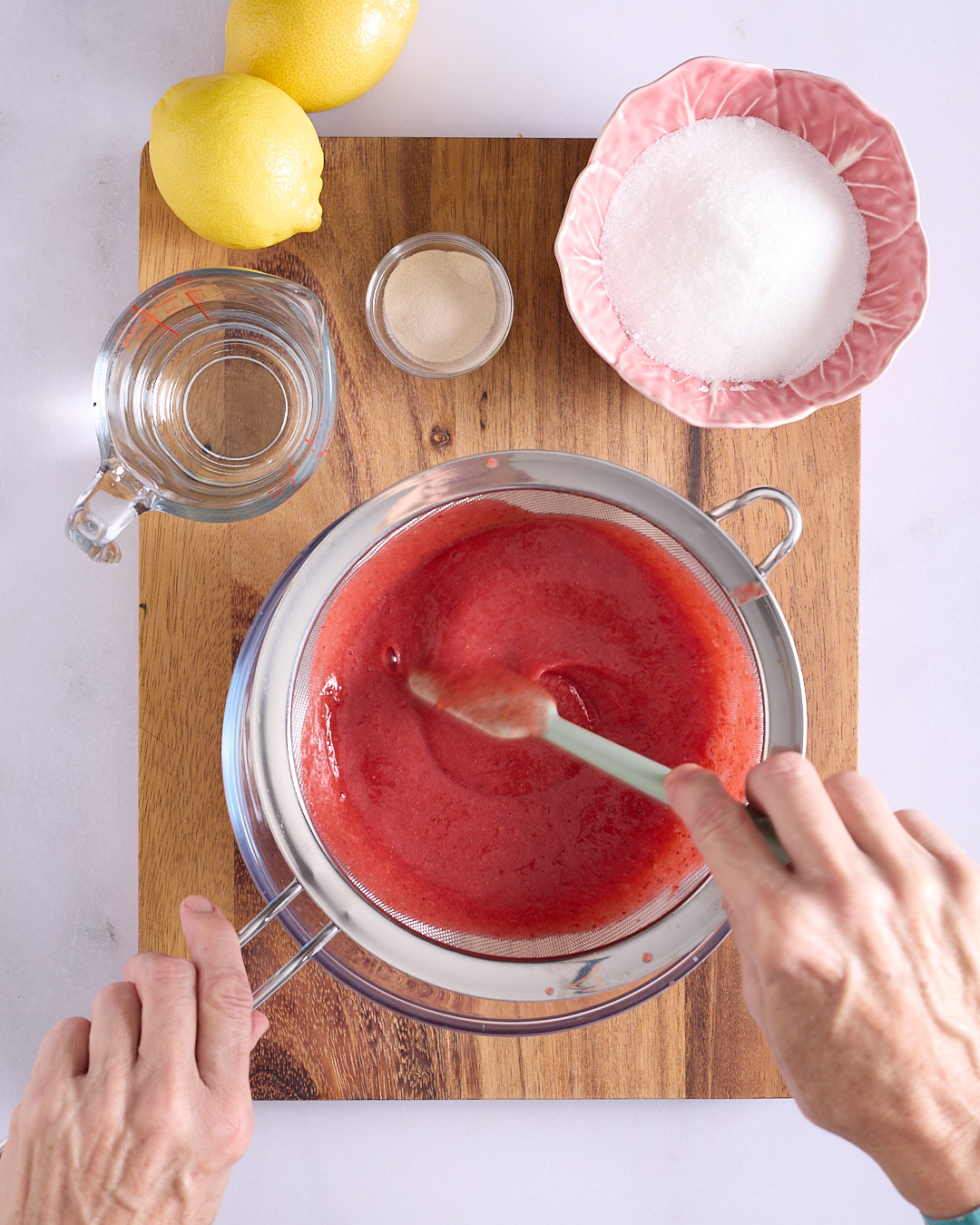
Process the defrosted strawberries in a blender or food processor until fully pureed with no lumps. Pass the puree through a fine sieve into a bowl and measure out the 250g required for the recipe. I recommend using any leftover puree on your breakfast yoghurt—don’t let it go to waste.
Have a container ready—preferably glass—with sides. I used a 20cm x 20cm Pyrex dish.
In a medium pot, combine 105g water, 55g fresh squeezed lemon juice, and the 250g of strawberry puree. Heat the mixture through to approximately 45°C.
Next, stir in the sugar and agar mixture. Continue stirring until the sugar has dissolved and the mixture comes to a boil. You need it to reach between 85°C and 95°C; agar-agar simply will not set unless it reaches this hydration point. If you don’t have a thermometer, make sure the mixture comes to a full boil and keep it there for about 90 seconds. Don’t be tempted to keep boiling beyond that, or you’ll destroy the fresh strawberry flavour and eventually break down the agar structure.
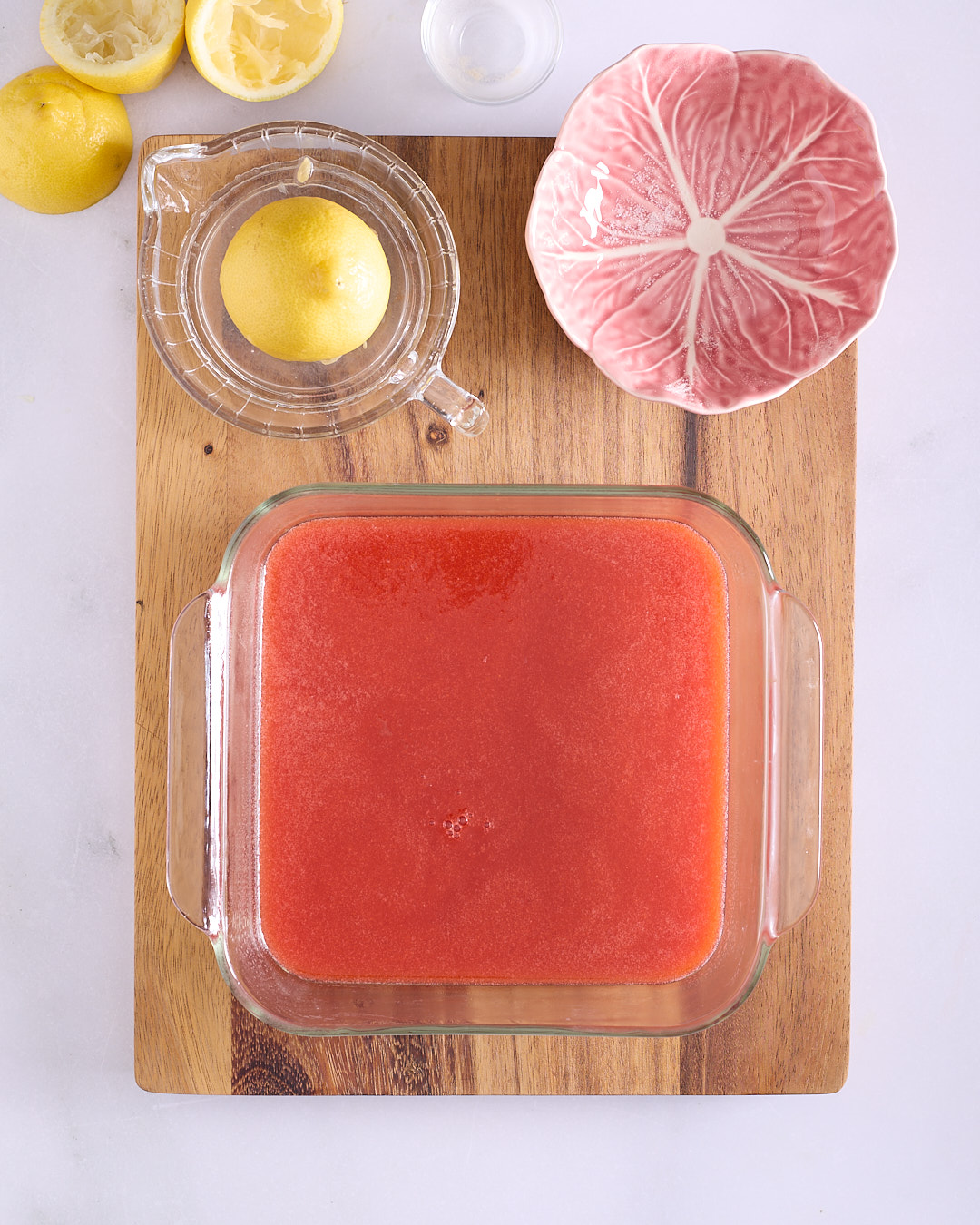
Pour the mixture into your container and leave it on the bench to cool to room temperature. Agar-agar sets up quickly as it cools. Once set, store it covered in the fridge until you’re ready to assemble the cake.
Making a whipped white chocolate ganache is a two-day exercise in patience
If you’re looking for a quick fix, this isn’t the recipe for you. A stable, pipeable whipped white chocolate ganache relies on the science of crystallisation, and that only happens with a long, cold rest in the fridge.
Before touching the chocolate, you need to bloom 6g of gelatine sheets in a bowl of ice water. Once they’re soft and pliable, you’re ready to start.
I weigh 360g of white chocolate and 30g of glucose into a tall jug or bowl. You need to gently soften the chocolate in the microwave using 15-second bursts on medium power. Don’t try to melt it completely; you just want it starting to lose its shape.
Once softened, squeeze the water out of your bloomed gelatine and add it to the warm chocolate.
While the chocolate softens, I heat 255g of pure cream (Cream A) in the microwave using short bursts until it’s very hot but not boiling. I then pour the hot cream directly over the chocolate and gelatine mixture and leave it to sit for a few minutes. This allows the residual heat to finish melting the chocolate and ensures the gelatine is fully dissolved.
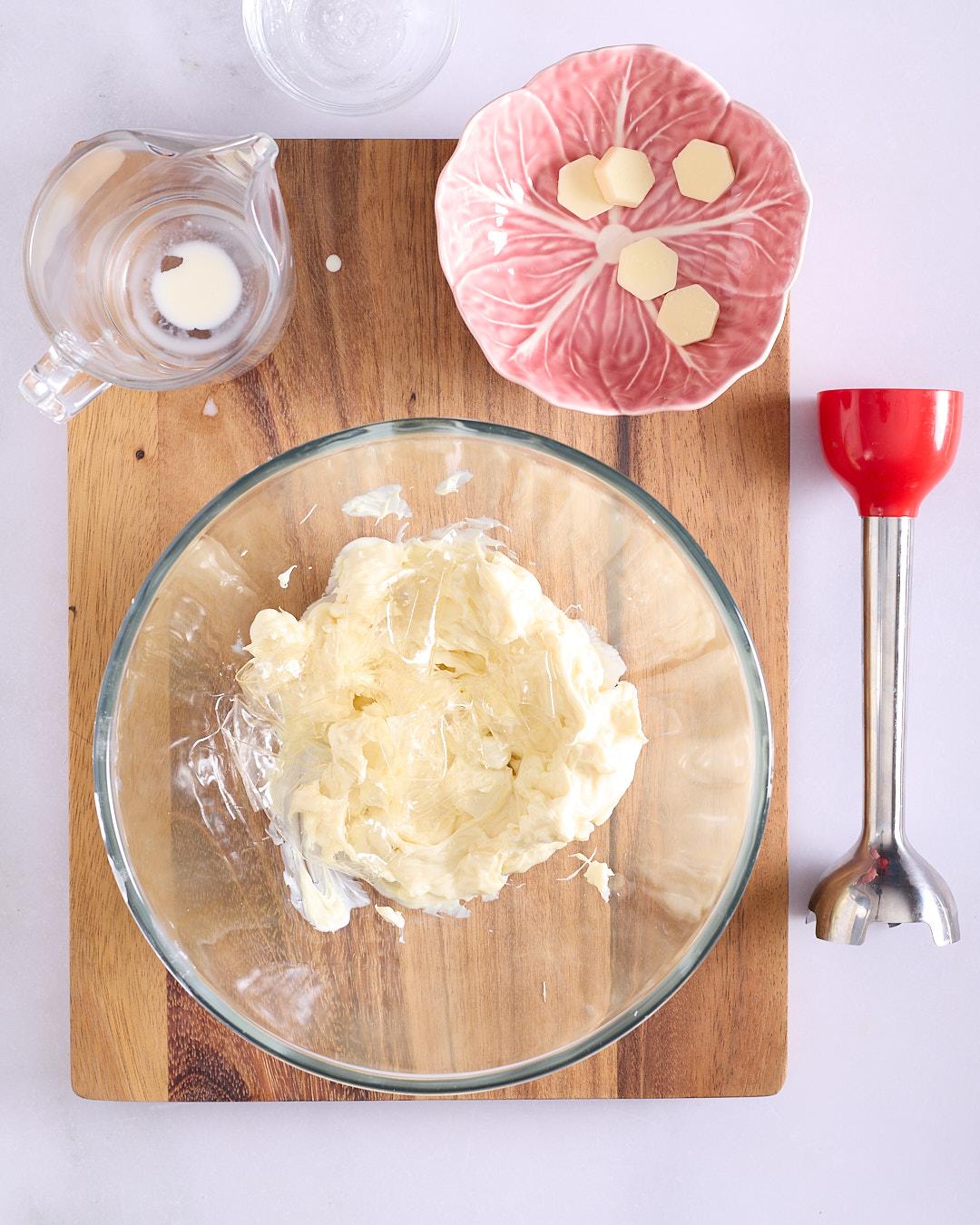
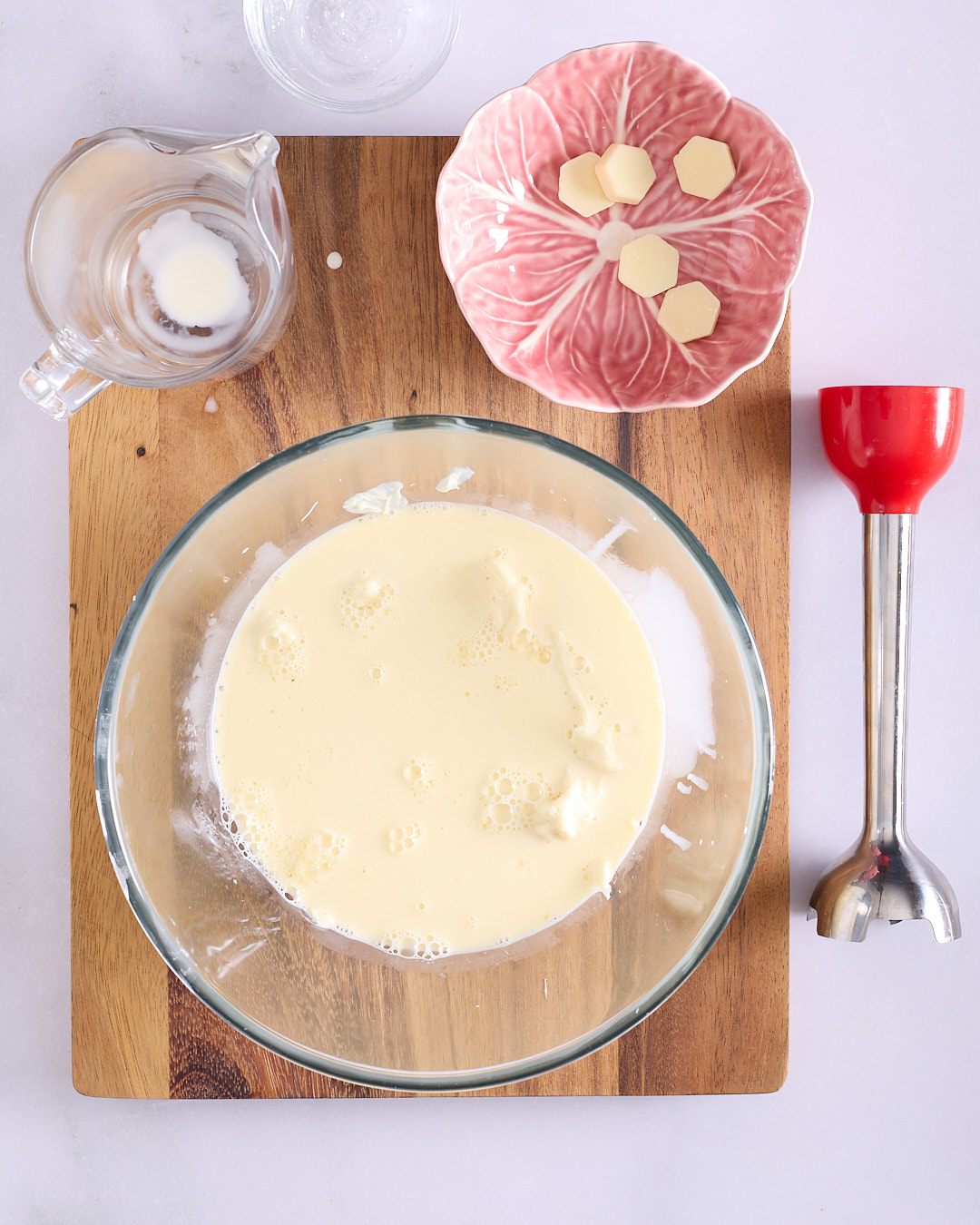
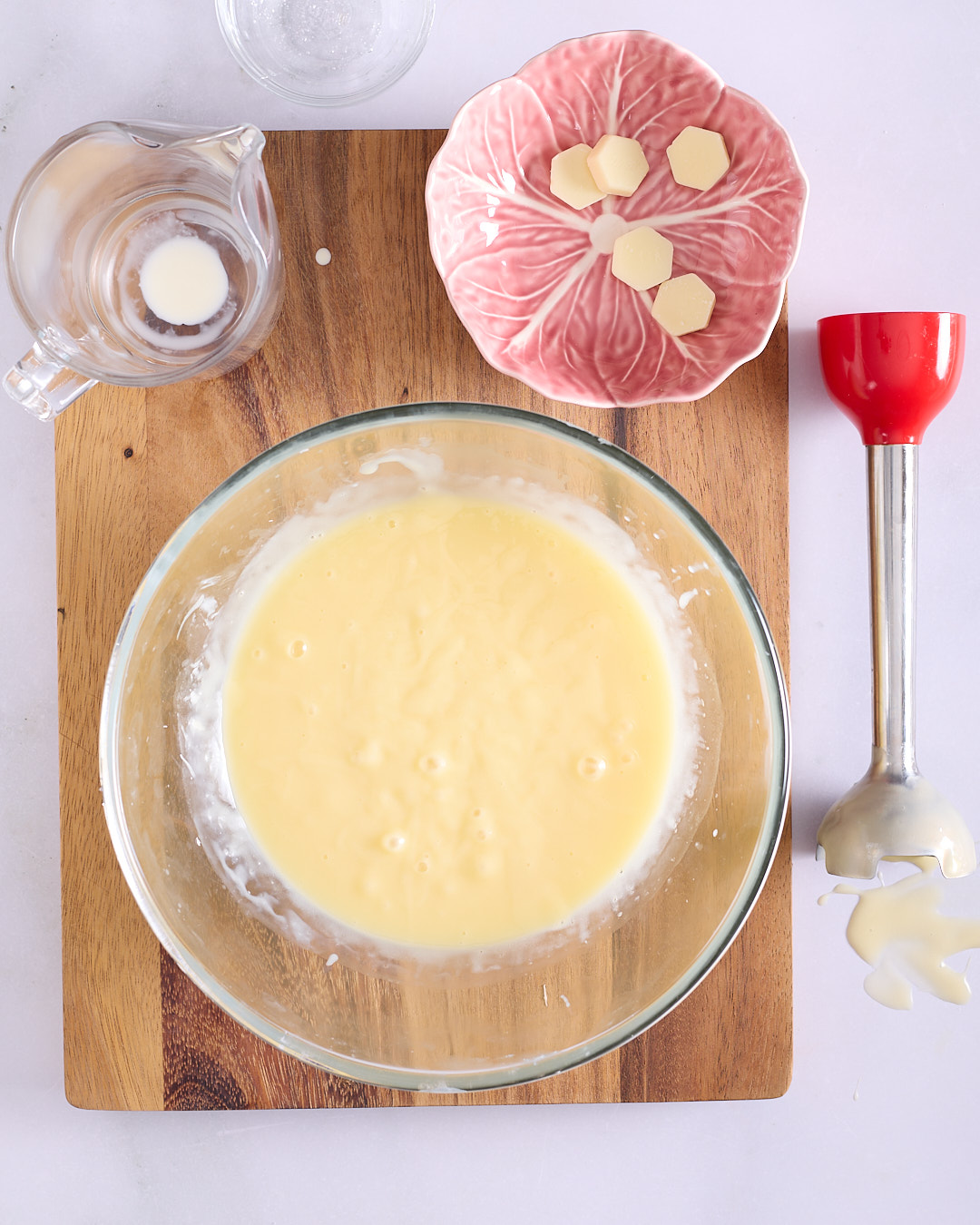
Now for the part that requires a bit of gear. Ideally, you should use an immersion blender (stick blender) to emulsify the mixture. Insert the blender to the bottom of the bowl and whiz (without lifting the blender) until the mixture is smooth, glossy, and pale yellow. Don’t use electric beaters here; we aren’t trying to incorporate air yet—that happens tomorrow. If you don’t have an immersion blender, you can gently hand whisk, keeping the whisk on the bottom of the bowl.
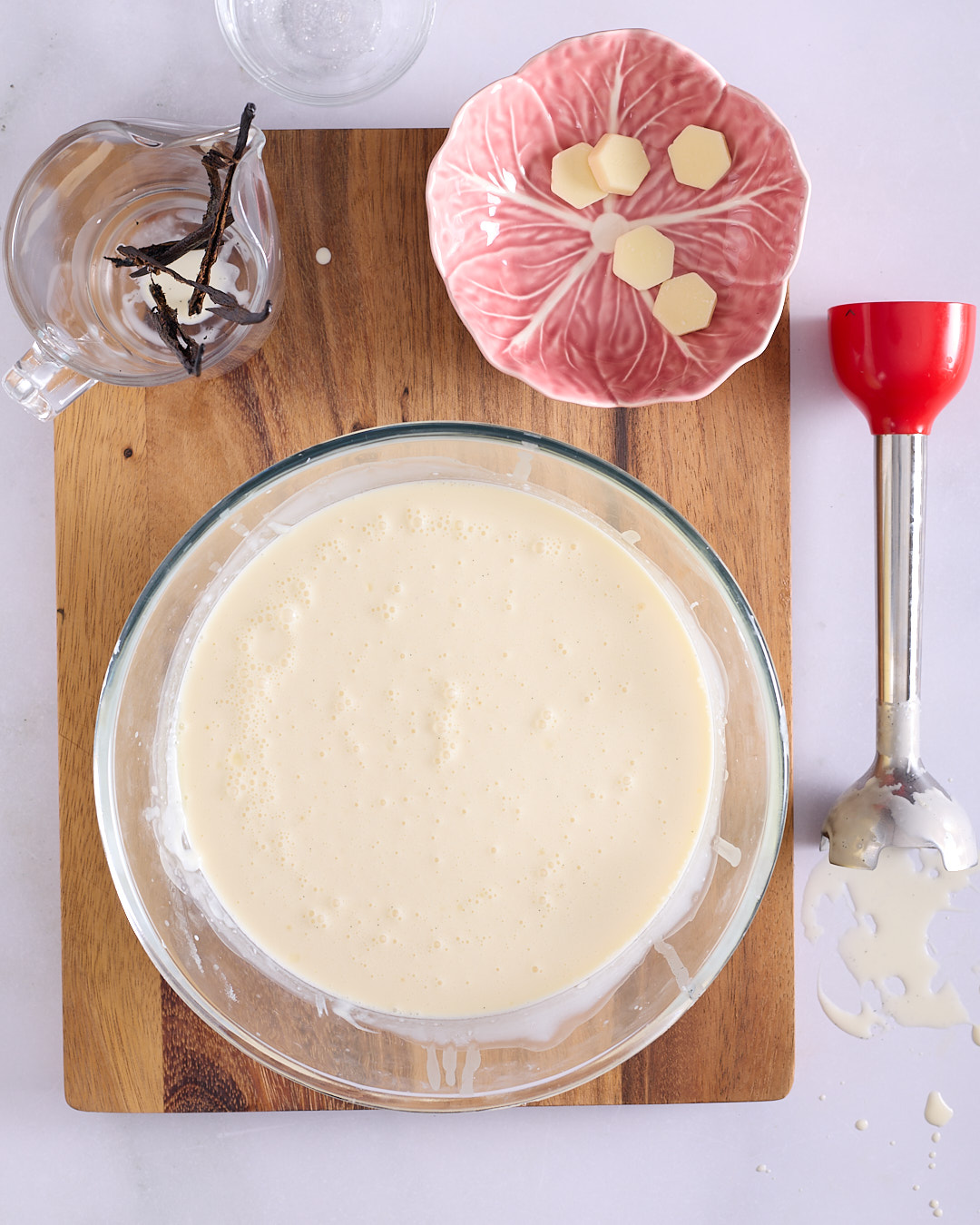
Remove the seeds from 3 vanilla pods and scrape them into the bowl of chocolate mixture. Alternatively, use 2 teaspoons of vanilla essence.
Finally, I add 780g of cold pure cream (Cream B) straight from the fridge and blend again until the mixture is completely homogeneous. Check that the vanilla seeds are fully incorporated.
I then press plastic wrap directly onto the surface of the liquid to prevent a skin forming and tuck it into the fridge. It needs at least 6 hours—overnight is better—before it is stable enough to whip into a frosting that will hold up a filled four-layer vanilla chiffon cake.
Vanilla chiffon cake method
What you need to bake the cake
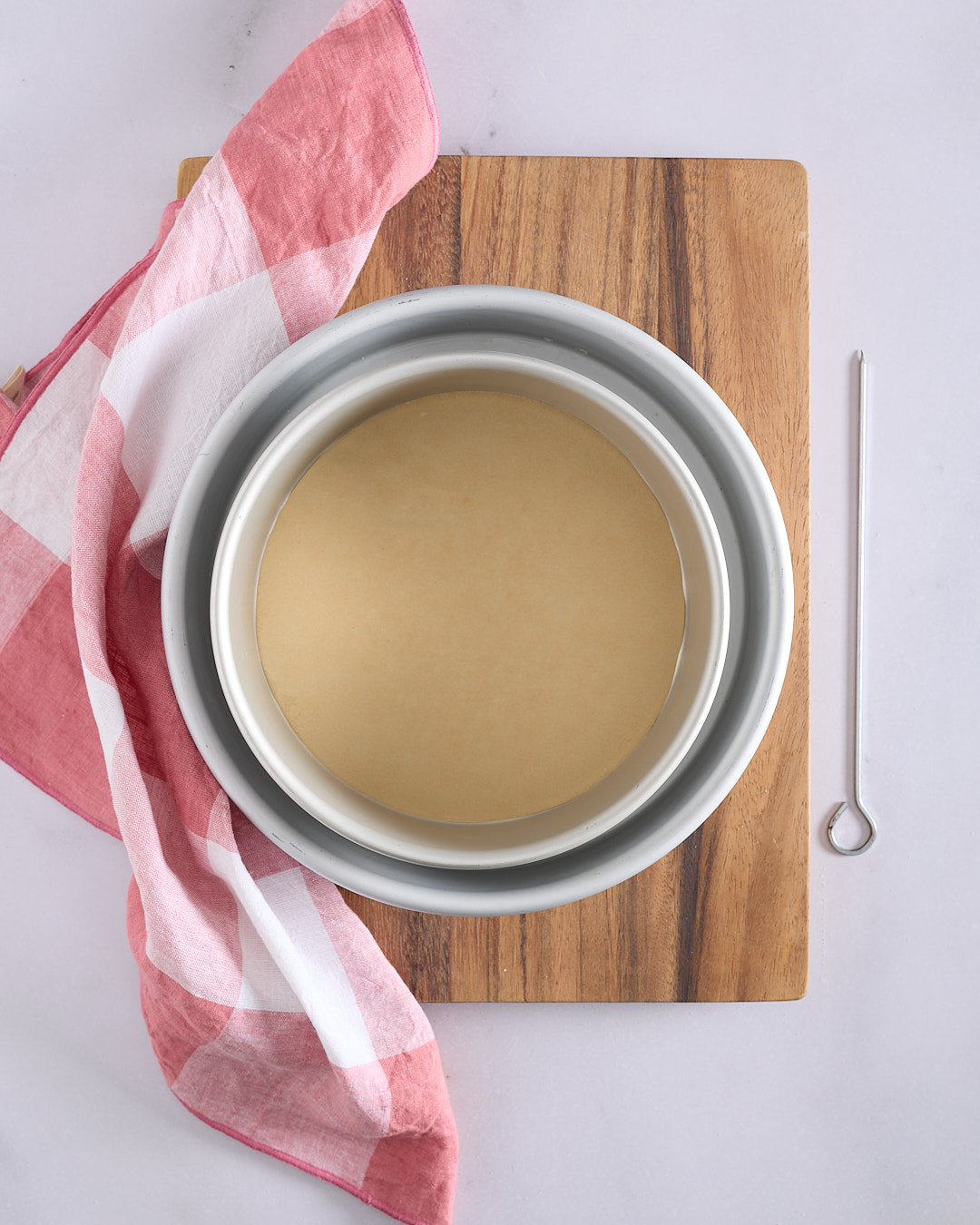
Chiffon cakes are traditionally baked in a tube pan, much like an angel food cake. But if you’re planning to use them in a layer cake, they can be baked in a standard cake pan—just ensure you don’t use a non-stick one. For my Strawberry Basil White Chocolate Chiffon Cake, I used two 8-inch (20cm) cake pans.
I line the bottom of each pan with baking paper, but here is the rule you cannot break: do not grease the pan and do not line the sides. The chiffon batter needs to be able to ‘climb’ up the sides of the pan as it bakes to reach its full height. If the sides are greasy, the cake will simply slip and sink.
Chiffons are also notorious for cracking on top, which is most unhelpful when you’re trying to stack a level layer cake. To keep the surface smooth and flat, I bake the cakes in a hot water bath, or bain-marie. This technique slows the baking process down and prevents the cake from rising too quickly. It results in a perfectly level surface, which makes layering your showstopper so much easier.
I use two 10-inch (25cm) cake pans to hold the water for the bain-marie.
A metal skewer is also handy to have nearby. I use it to remove air bubbles from the batter before the cakes go into the oven.
Chiffon cake method
Preheat the oven to 170°C fan forced, with the rack in the middle of the oven. Depending on the size of your oven you may have to bake the cakes on 2 racks.
Boil the kettle; you will be using 140ml of ‘just boiled’ hot water for the cake batter. I keep reboiling the kettle as I go so the hot water is ready exactly when I need it.
Carefully separate 12 large eggs, ensuring not a single speck of egg yolk ends up with the egg whites. If you contaminate the whites, they won’t whip to the height you need for this cake. Weigh out 200g of egg yolks into one bowl and 175g of egg whites into another. Set them aside until required.
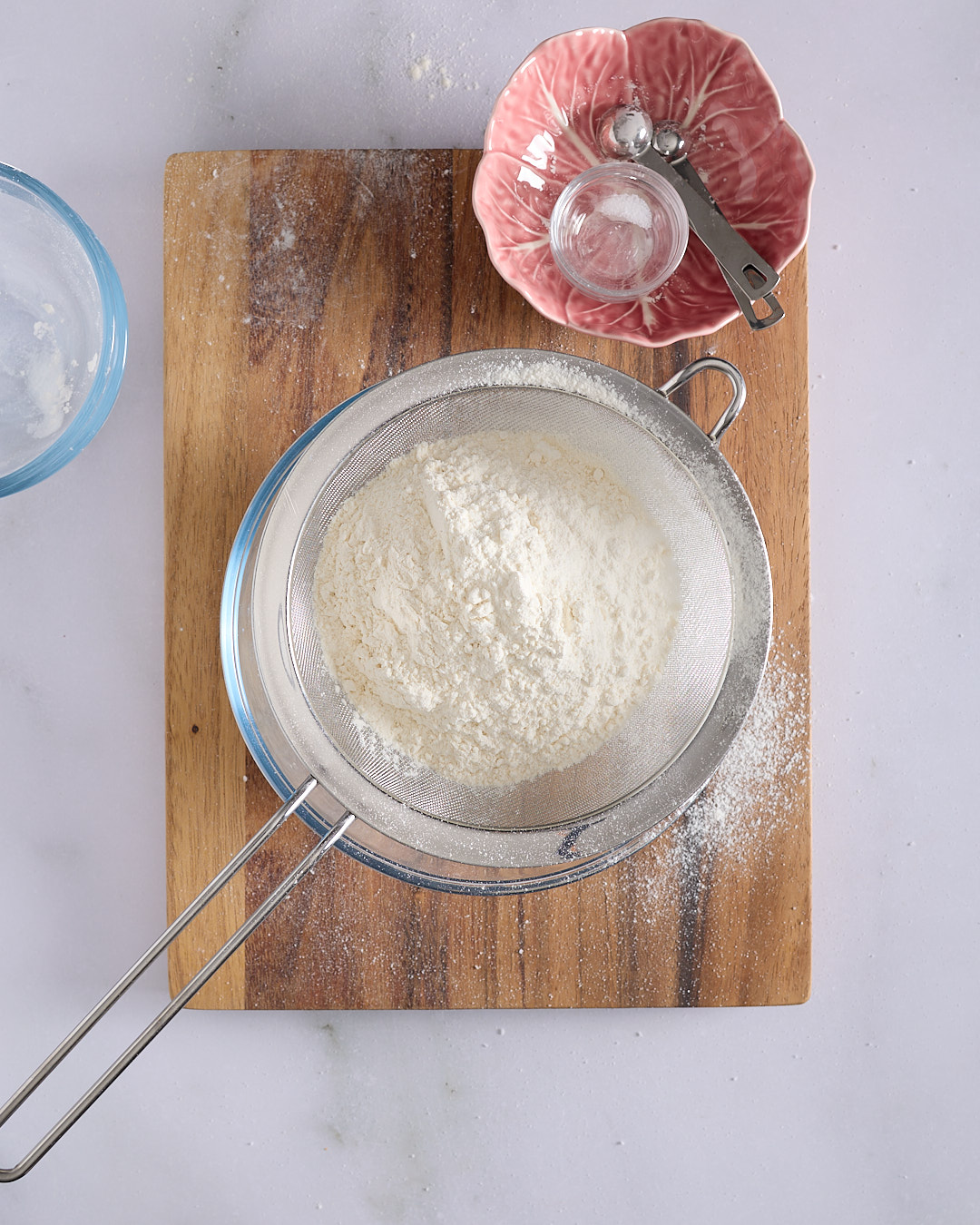
Sift the following dry ingredients into a medium sized bowl and set aside until required:
- 270g cake flour
- 95g caster sugar (A)
- ¾ teaspoon baking powder
- ¼ teaspoon salt
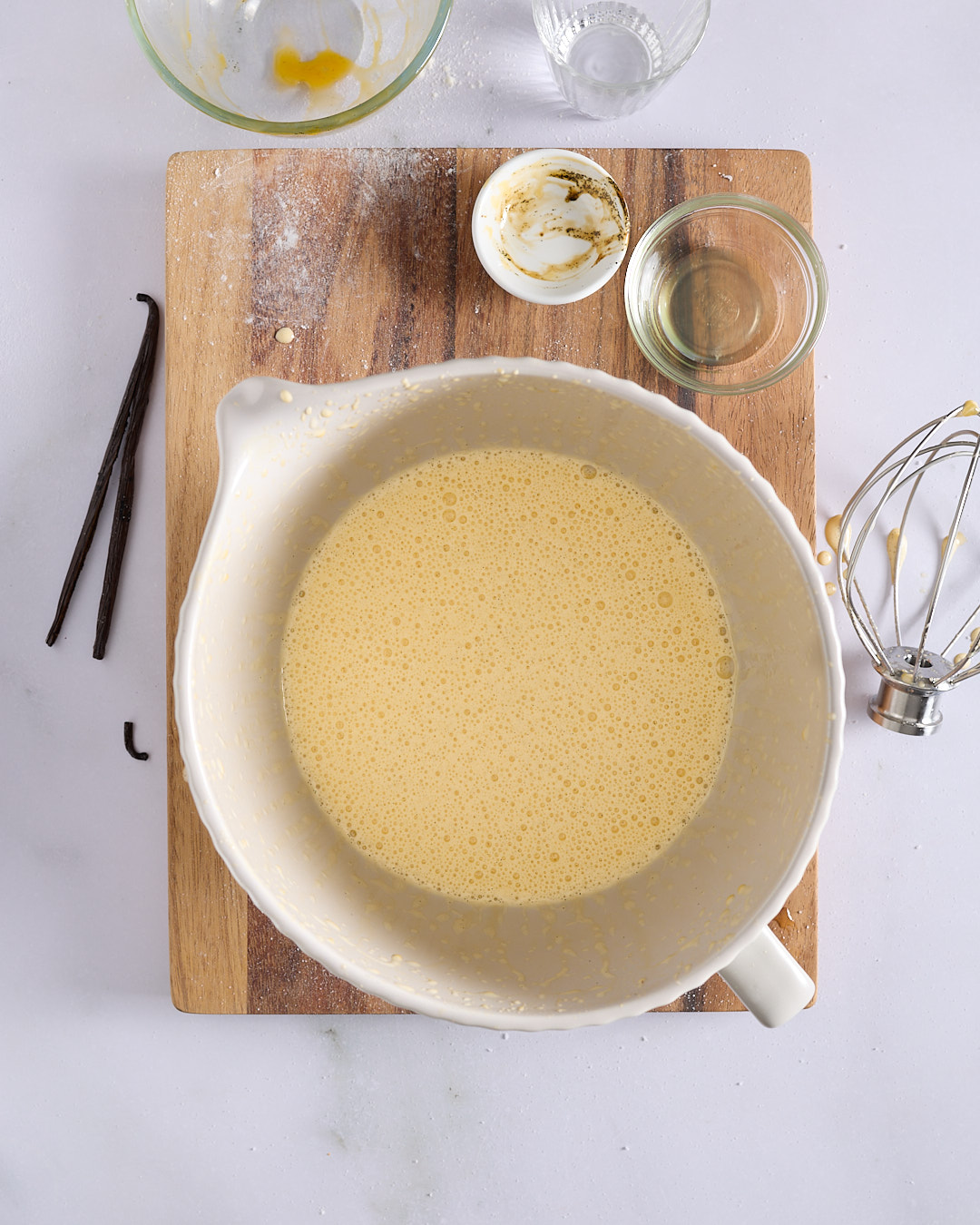
Boil the kettle again. You want that water just coing off a rolling boil when it hits the bowl. Split the vanilla bean and scrape out those seeds.
Place the 200g egg yolks, 145g grapeseed oil, and the vanilla seeds in the bowl of your stand mixer. Fit the whisk attachment and start on medium speed. Gradually drizzle in the 140ml of just-boiled water. Crank the speed up to high and whisk for 6 to 8 minutes. You aren’t just combining them; you’re looking for the mixture to triple in volume.
If you don’t have a second bowl for your stand mixer, scrape the yolk mixture gently into another large bowl and set it aside. Now, here is the no-nonsense bit: you must wash and dry the whisk attachment and the stand mixer bowl with obsessive care. Not a single trace of grease or yolk can remain, or your egg whites will not whip into a meringue in the next step.
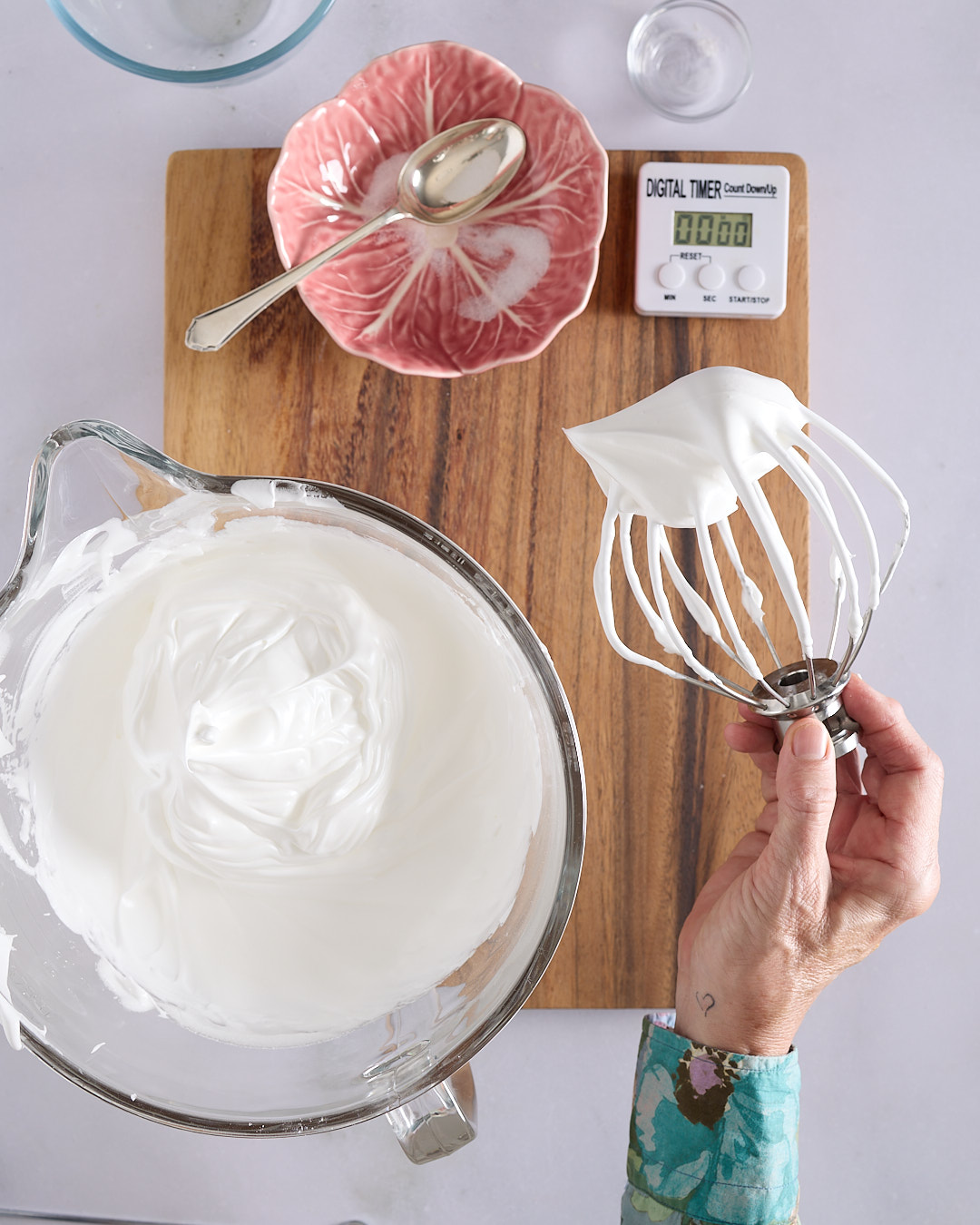
Place the 175g egg whites and 1 ¼ teaspoon cream of tartar in the bowl of your stand mixer. Fit the whisk attachment and beat the egg whites on medium speed until you have reached the soft peak stage. This should take about 1 to 2 minutes.
Now, pay attention, as this is arguably the most critical instruction in this strawberry basil white chocolate chiffon cake recipe. Set a timer for ten minutes. Then start adding the 180g of caster sugar (B) 1 teaspoon at a time. Continue on medium speed until every grain of sugar has dissolved and you have reached the firm peak stage.
To be certain the sugar is fully incorporated, take a small amount of the meringue and rub it between your thumb and forefinger. If you can feel even a hint of grittiness, the sugar hasn’t dissolved yet, so keep whipping. You may well need that full 10 minutes on the timer to ensure the meringue is stable enough for the chiffon cake to support the weight of the strawberry basil gel and the whipped white chocolate ganache.
Boil the kettle again for the bain-marie before proceeding with the next step.
The next steps in creating your vanilla chiffon sponge are to fold the egg white meringue into the whipped egg yolk mixture and add the dry ingredients.
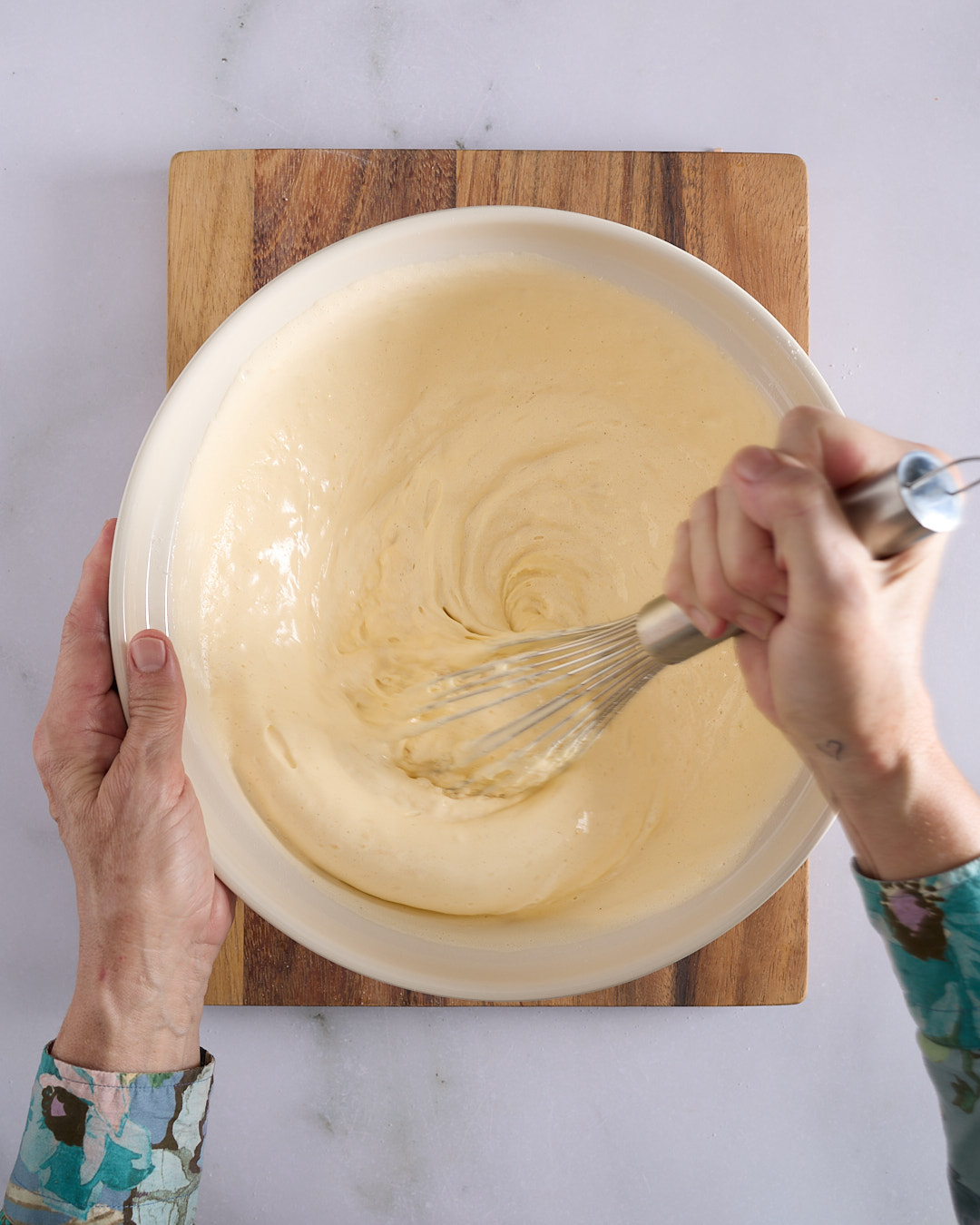
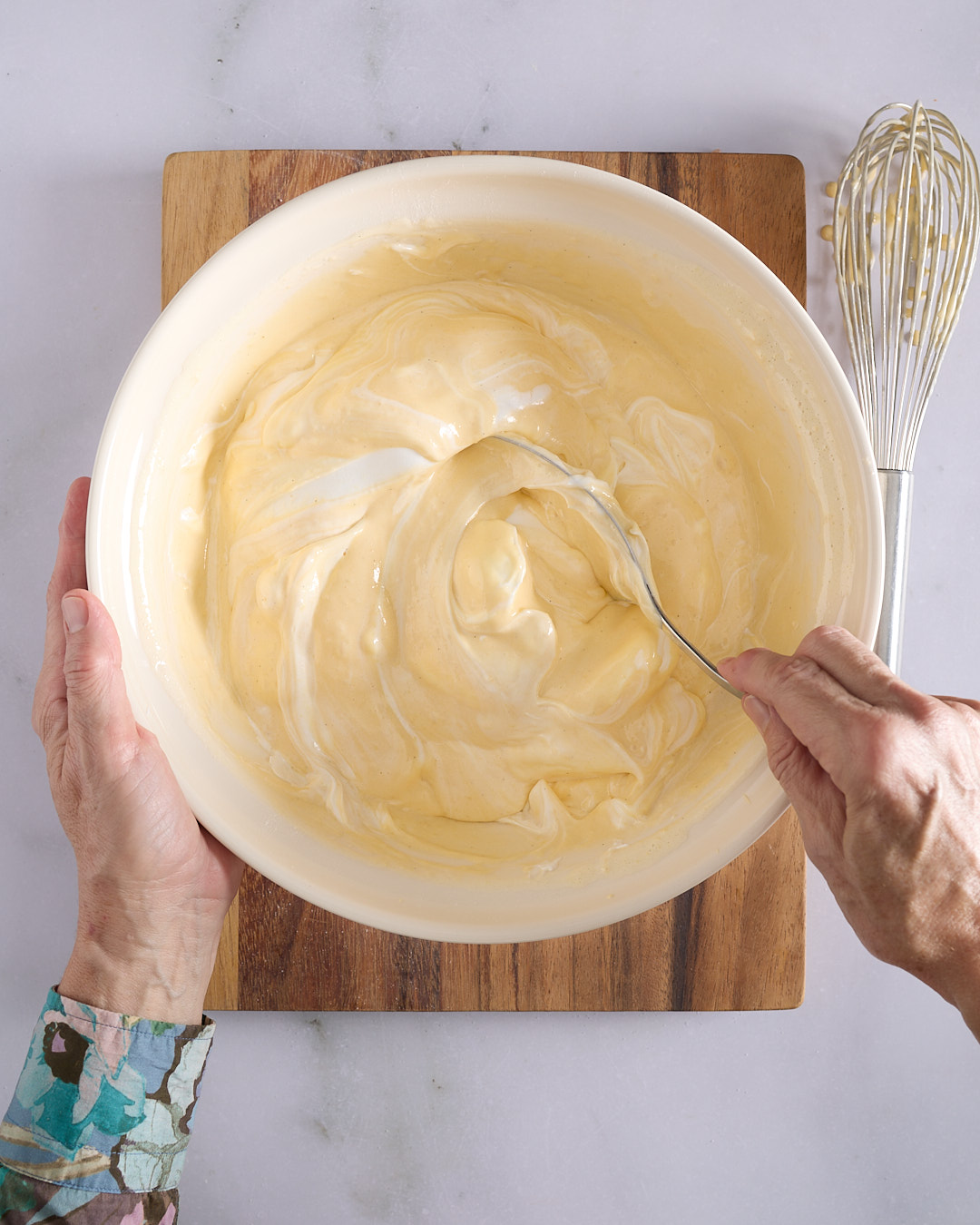
To ensure you can combine the 2 mixtures without unnecessarily deflating the meringue, it’s best to loosen the egg yolk mixture first. Add about one-third of the meringue mixture to the bowl with the egg yolk mixture. You can afford to be a bit firm here; whisk it vigorously by hand with a balloon whisk until the meringue is no longer visible. This lightens the density of the yolks, making it much easier to fold in the remaining meringue without losing the loft required for a perfect strawberry basil white chocolate chiffon cake.
Next, add the dry ingredients in 2 batches, whisking between additions until just incorporated.
Finally, incorporate the remaining two-thirds of meringue into the batter. I use a large metal spoon for this, as the thin edge cuts through the foam much more efficiently than a blunt spatula, helping to maintain the volume we’ve worked so hard to build.
You want to use a large figure-eight motion, scraping the bottom of the bowl and turning it as you go. Stop the moment you can no longer see streaks of white or pockets of flour. Over-folding at this stage is the quickest way to end up with a flat cake.
Once the batter is homogeneous, divide it evenly between your 2 prepared 8-inch (20cm) cake pans. Run a metal skewer through the batter to remove any large pockets of air.
Carefully pour the ‘just boiled’ water from your kettle into the larger 10-inch (25cm) pans until it reaches about 3cm up the sides. Then place each 8” pan inside a larger 10” pan. This creates the bain-marie environment that ensures your vanilla chiffon sponge bakes evenly with a level, crack-free top.
Slide the nested pans into the centre of your preheated oven at 170°C fan forced. Immediately turn the heat down to 155°C.
Bake for 35-40 minutes. Resist the urge to open the door early; chiffon cakes are sensitive to sudden temperature drops. Don’t start checking the cakes before 35 minutes. The cake is done when the top is golden and springs back when lightly touched, or a cake tester comes out clean.
While the cakes are baking, layer 2 kitchen towels on the bench and separately set up a cake rack for the vanilla chiffon cakes to cool. Immediately upon removing the baked cakes from the oven, drop each cake onto the towel from about 15cm to knock out any air pockets. The cake will slightly deflate once dropped. Then invert the cake onto the rack. If the cake does not immediately drop onto the rack, reinvert and run the back of a small thin paring knife around the edge of the cake and invert again on the rack. Then gently peel back the baking paper liner.
Cool to room temperature and then refrigerate before slicing in half crosswise to create 4 layers. I uselessly make the cakes a few days in advance, wrap them well in plastic wrap, and store them in the freezer. I then defrost overnight in the fridge the day before I plan to assemble the cake.
Your vanilla chiffon sponge layers are now ready to meet the strawberry basil gel and the whipped white chocolate ganache.
Final steps for a showstopping chiffon cake
Fresh strawberry basil gel
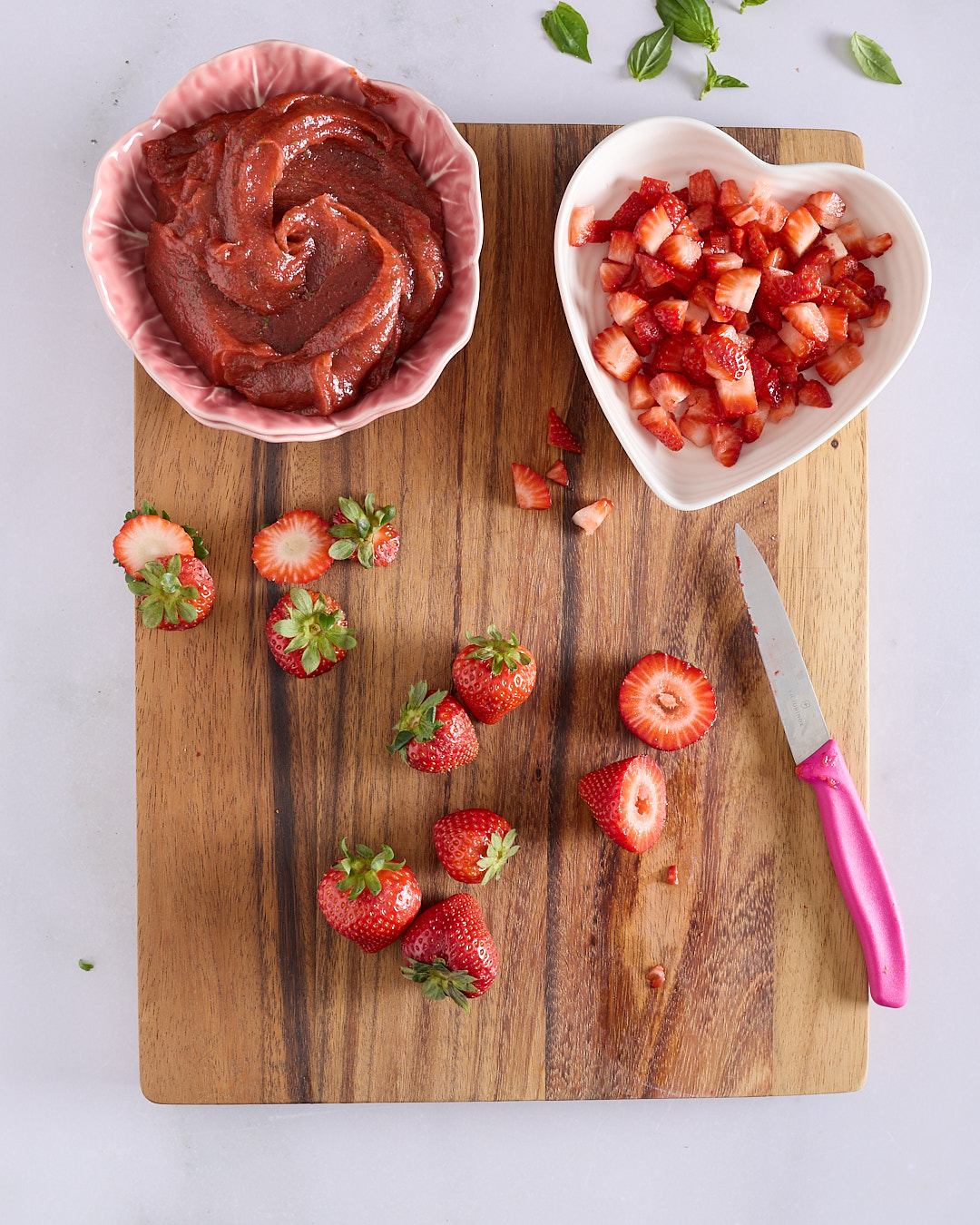
Before you assemble the strawberry basil white chocolate chiffon cake, you need to finish the gel. Get your food processor or blender out and process the set strawberry-agar block with 8g of fresh sweet basil leaves.
Be picky with your basil. Discard any damaged or darkened leaves; you only want the youngest, sweetest leaves to ensure the flavour remains bright and doesn’t tip into a medicinal or ‘bruised’ note. Blitz until the firm agar-gar gel becomes a smooth paste and the basil is completely incorporated.
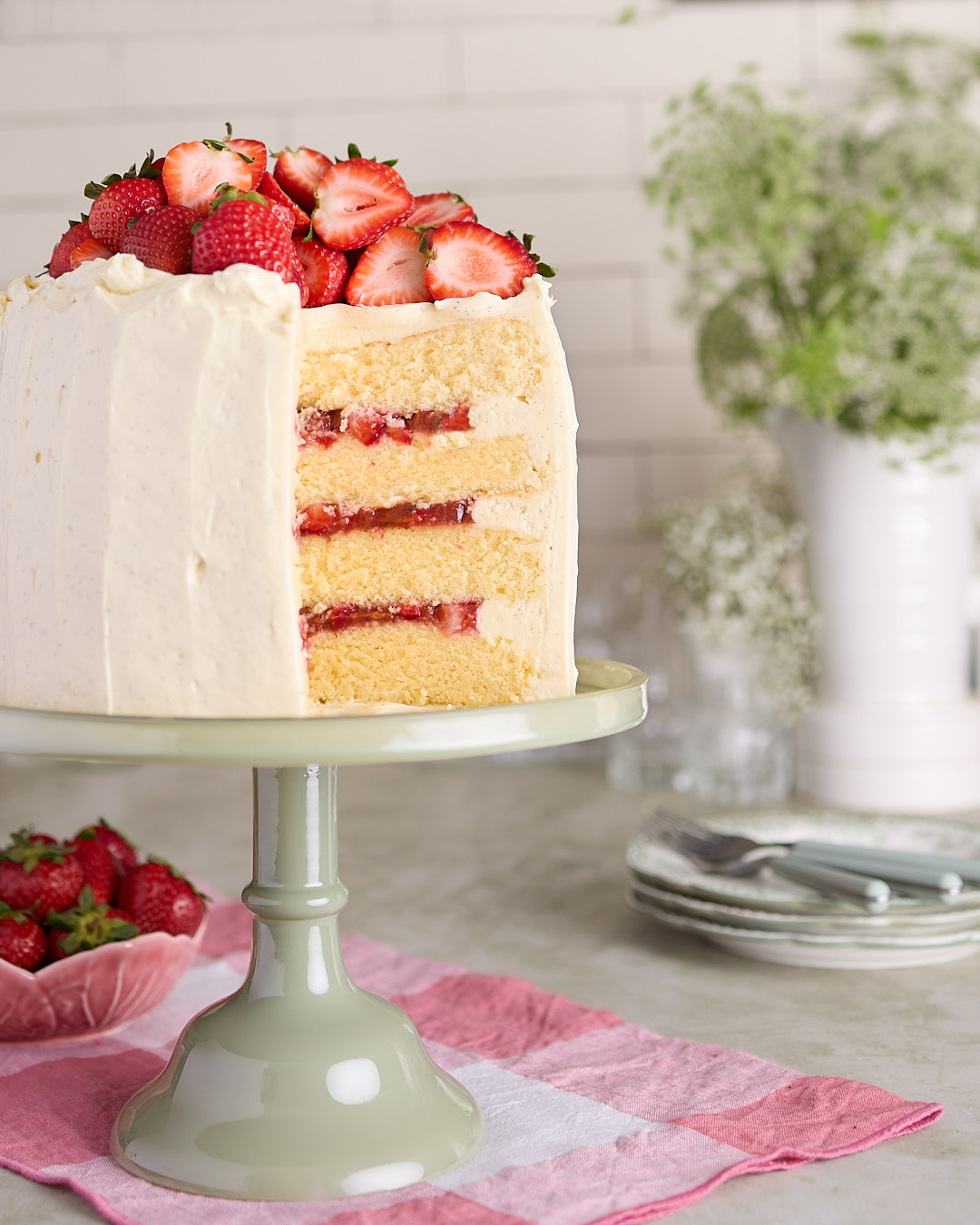
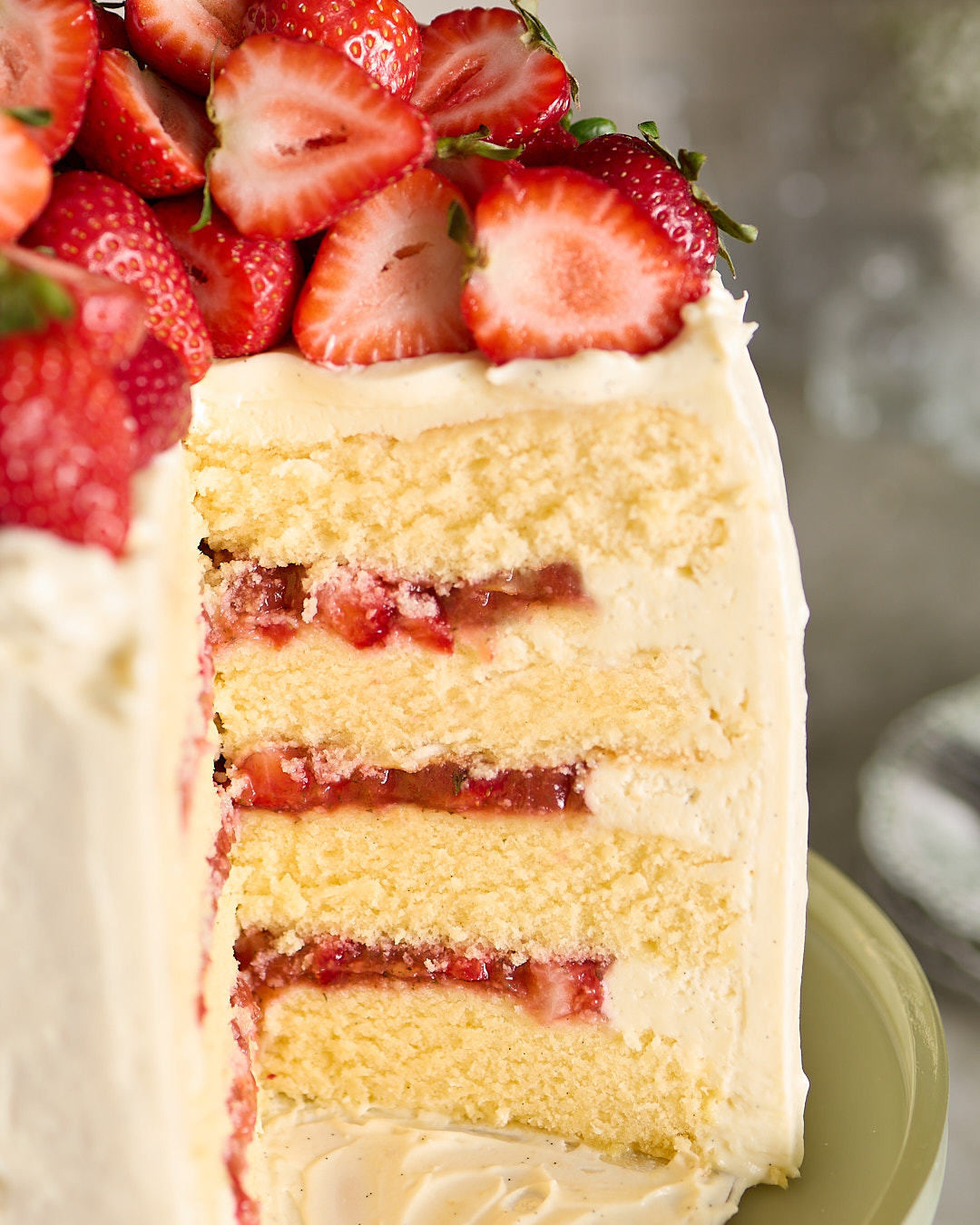
Finely chop 250g of fresh strawberries into small cubes (about 5mm to 7mm). Thoroughly mix these into the strawberry gel by hand. This gives you those bursts of fresh fruit texture you see in the cross-section of the vanilla chiffon sponge.
Transfer the finished mixture into a large tipless piping bag and refrigerate it until you are ready to build the layers.
Whipped white chocolate ganache
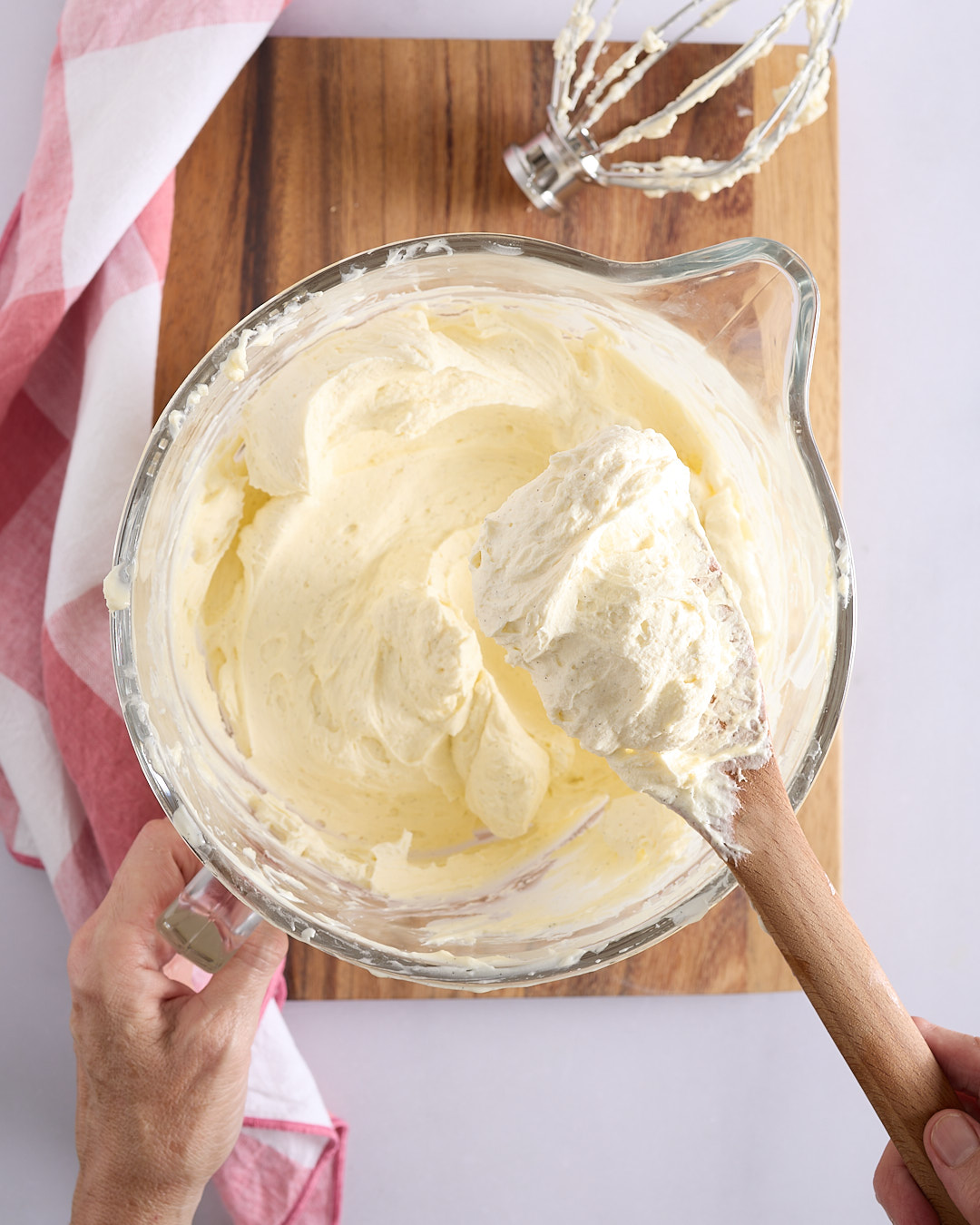
Just before you’re ready to assemble the strawberry basil white chocolate chiffon cake, whip the chilled ganache using a stand mixer with the whisk attachment (or electric beaters). Beat the mixture until it is thick and dense, just past the firm peak stage. You need this level of stability for it to hold its shape when piped and to support the weight of the vanilla chiffon sponge.
Because we’ve included glucose in the base, the ganache is much more stable and forgiving than a standard cream-and-chocolate mixture. The glucose helps prevent the emulsion from splitting or turning to grainy ‘white chocolate butter’ too quickly, giving you a wider window to reach that perfect, pipeable consistency. Stop once it holds its shape on the whisk and looks matte and thick.
Cake stacking is all about the architecture
While we’ve established that the sky-high version in the photo was a result of some cake-vanity and extra baking, your four-layer cake—neatly sliced from 2 perfect chiffon sponges—still needs proper architecture to stay stable. The key is level layers, even filling, and a firm structural dam to keep that strawberry basil gel from escaping.
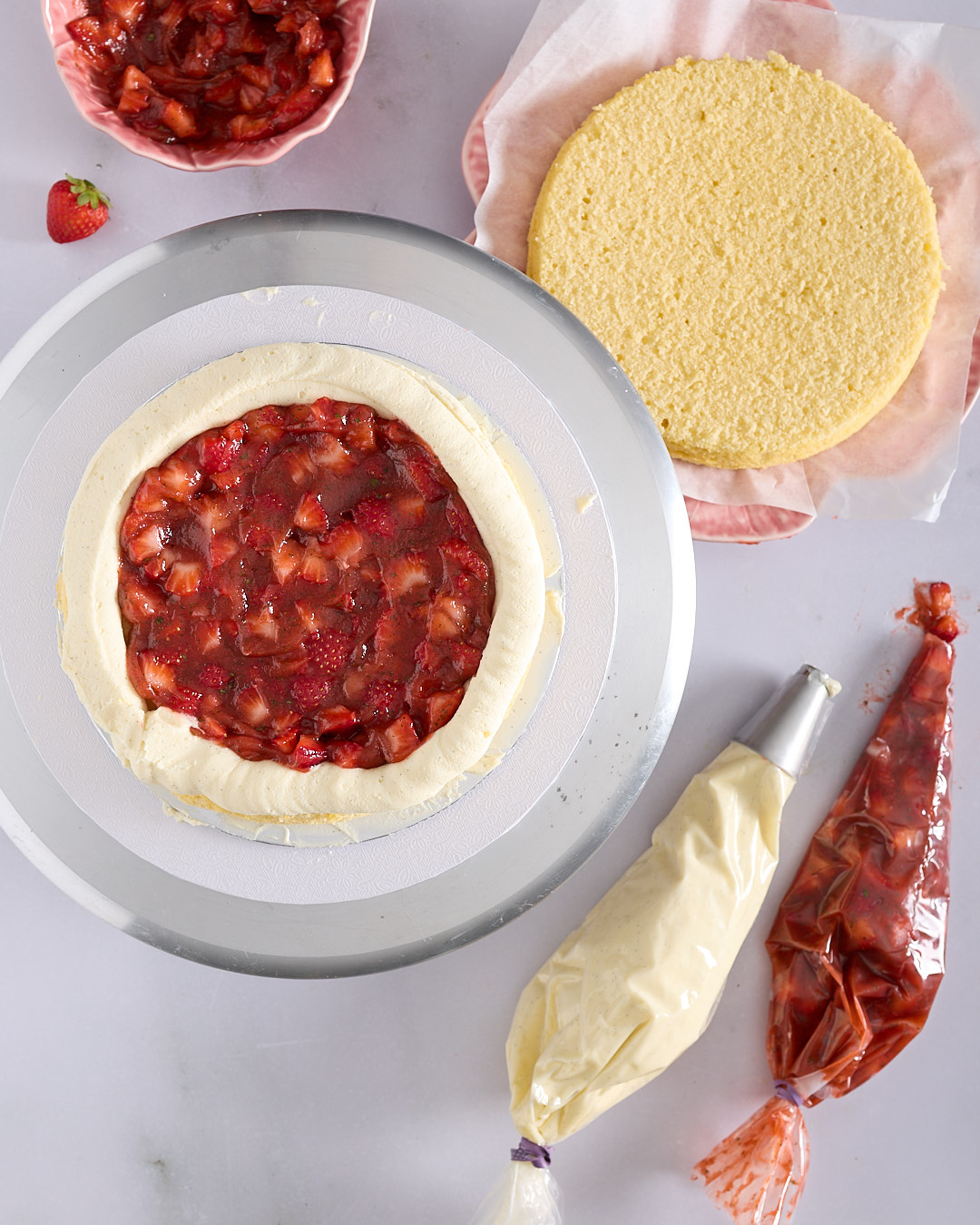
Transfer about a third of the whipped white chocolate ganache to a piping bag fitted with a 1cm round tip.
Slice each of your vanilla chiffon sponge cakes in half crosswise to create 4 even layers. Place a non-slip mat on your cake turntable and ‘glue’ a 10 or 12-inch cake board on top with a dab of ganache. Place your first cake layer on the board, trimmed side up. Pipe a thick dam of whipped ganache around the outer edge. This acts as a structural wall to keep the filling in place. Fill the centre with the strawberry basil gel, smoothing it out with an offset spatula or spoon so it sits just below the height of the ganache wall.
Repeat the process for the second and third layers. If the ganache starts to soften or it is a warm day, I place the partly assembled cake in the fridge, still on the cake stand, and let it firm up a bit before continuing. Don’t let the ganache set fully as you’ll have to wait for it to soften slightly before continuing.
Place the final cake layer on top, trimmed side down, to give you a perfectly flat surface for frosting. Apply the crumb coat and scrape off the excess ganache with a cake scraper or long palette knife. The purpose of the crumb coat is to use a thin layer of ganache to seal in any stray crumbs, chill for 30 minutes, and then apply your final, thicker coat of frosting using any style you wish to finish your strawberry basil white chocolate chiffon cake. I have chosen a simple finish by drawing a wide offset palette knife up the sides of the cake to form overlapping bands/stripes of frosting.
As this vanilla chiffon sponge is made with oil, the crumb will stay soft when you refrigerate the decorated cake. I have topped the cake with a mountain of fresh strawberries.
This cake is at its best on the day you assemble it. It is not necessary to bring the cake to room temperature before serving. It is actually better if you slice the chilled cake and let the plated slices sit for a few minutes before serving to allow the whipped white chocolate ganache to soften slightly.
I hope you get a chance to try this delightfully fresh botanical cake recipe. Please let me know what you think if you do.
Strawberry Basil White Chocolate Chiffon Cake

Equipment
- Digital kitchen scales
- Stand mixer with whisk attachment
- Immersion blender
- Food processor (or blender)
- 2 x 8-inch (20cm) standard cake pans (not non-stick)
- 2 x 10-inch (25cm) pans (to act as a bain-marie)
- Palette knife (offset and straight)
- Cake scraper
- Cake turntable (optional)
- Large piping bags
- 1cm round piping tip
Ingredients
Vanilla chiffon sponge:
- 270 g cake flour
- 95 g caster sugar (A)
- 180 g caster sugar (B)
- ¾ teaspoon baking powder
- ¼ teaspoon salt
- 200 g egg yolks (approx. 12 large eggs)
- 175 g egg whites
- 145 g grapeseed oil
- 1 vanilla bean (seeds only or 2 teaspoons vanilla essence)
- 140 ml just-boiled water
- 1 ¼ teaspoons cream of tartar
Strawberry basil gel:
- 250 g strawberry puree (processed from 500g frozen strawberries)
- 105 g water
- 55 g fresh lemon juice (approx. 2 lemons)
- 85 g caster sugar
- 8 g agar-agar powder
- 8 g sweet basil leaves (approx. 2 small bunches)
- 250 g fresh strawberries (finely chopped for filling)
Whipped white chocolate ganache:
- 360 g white chocolate (minimum 23% cocoa solids)
- 30 g glucose syrup
- 6 g gelatine sheets
- 255 g pure cream (A - minimum 35% fat content)
- 780 g pure cream (B)
- 3 vanilla pods
- 250 g fresh strawberries
Instructions
Prepare the whipped ganache (day before):
- Bloom the gelatine in a bowl of ice water for 5 minutes.
- Weigh the white chocolate into a large bowl and microwave in 15-second bursts until softened.
- Heat cream (A) in the microwave until very hot but not boiling.
- Squeeze the water from the gelatine and add it to the warm chocolate.
- Pour the hot cream (A) over the chocolate and let sit for 2 minutes.
- Use an immersion blender to emulsify until smooth and glossy.
- Add the cold cream (B) and scrape in the seeds from 3 vanilla pods. Blend again until homogeneous.
- Press plastic wrap onto the surface and refrigerate for at least 6 hours or overnight.
Prepare the strawberry basil gel (day before):
- Mix the sugar and agar-agar together in a small bowl.
- Combine 105g water, 55g lemon juice, and 250g sieved strawberry puree in a medium pot.
- Heat the mixture to 45°C, then stir in the sugar and agar mixture.
- Bring to a full boil (85°-95°C) and hold at a boil for 90 seconds while stirring.
- Pour into a shallow dish and leave on the bench to cool, then refrigerate until set.
Bake the chiffon cakes:
- Preheat the oven to 170°C fan forced.
- Line the base of two 8-inch cake pans with baking paper. Do not grease the sides.
- Separate the eggs into yolks and whites.
- In a stand mixer with a whisk attachment, whisk the yolks, grapeseed oil, and vanilla seeds while gradually drizzling in 140ml of just-boiled water. Whisk on high for 6–8 minutes until tripled in volume. Gently place in a second bowl if you only have one stand mixer bowl.
- Clean your mixer bowl and whisk thoroughly.
- Keep the kettle boiled for the bain-maire below.
- Using the whisk attachment again, beat the egg whites and cream of tartar to soft peaks. Gradually add caster sugar (B) one teaspoon at a time over 10 minutes until firm peaks form and no grittiness remains.
- Add one-third of the meringue into the yolk base, whisk vigorously with a balloon whisk until well combined.
- Whisk in the sifted dry ingredients (cake flour, sugar A, baking powder, salt) in two batches until just incorporated.
- Gently fold in the remaining two-thirds of meringue using a large metal spoon.
- Divide the batter equally between the lined 8-inch pans. Run a metal skewer through the batter to remove large air bubbles.
- Fill the larger pans with 3cm of boiling water to create a bain-marie. Place the 8-inch pans inside 10-inch pans.
- Place pans in oven and immediately turn the heat down to 155°C fan forced. Bake for 35–40 minutes until golden and a cake tester comes out clean. To avoid deflating the cakes, do not open the oven before 35 minutes.
- Immediately drop the pans from 15cm onto a kitchen towel, then invert onto a rack to cool completely. If they do not come free, run the back of a paring knife around the edge of the cake and try again. Carefully remove the baking paper.
- Once cooled, chill the cakes well before assembling the layers.
Assemble the cake:
- Blitz the set strawberry-agar block with 8g fresh basil leaves until it forms a smooth paste.
- Fold the 250g of chopped fresh strawberries into the gel and transfer to a tipless large piping bag.
- Whip the chilled ganache on medium-high speed until thick, matte, and just past firm peaks. Transfer one-third to a piping bag with a 1cm tip.
- Slice each chiffon cake in half to create four layers.
- Secure the first layer on a cake board or serving plate cut side up with a thin layer of ganache. Pipe a thick dam of ganache around the edge of the cake. Fill the centre with the strawberry basil gel.
- Repeat for the second and third layers.
- Top with the final layer, trimmed side down.
- Apply a thin crumb coat of ganache and chill for 30 minutes.
- Frost with the remaining ganache and top with fresh strawberries.
- Chill well before slicing to serve.