Recipes

Cardamom Orange Knots

A dozen Cardamom Orange Knots arranged on parchment paper, each one twisted into a knot shape and finished with a golden, cardamom-sugared crust.

If you were to ask me, cinnamon roll or cardamom bun, the adult me answers “cardamom bun” every time. But the kid me would be asking “what’s a cardamom?” I have, without remorse or a look back at my childhood love, fallen hard for the Swedish kardemummabullar or cardamom bun. 

I have yet to make it to Sweden to try the most authentic kardemummabullar but I have sampled every version I come across at the local artisan bakeries I find while travelling. I am particularly fond of the knot version, kardemummaknutar. Clearly, I am not alone in this regard considering the number of cardamom knot tying reels that drop into my Instagram feed. 

Having no ready source of kardemummaknutar on the Gold Coast, I had to try and reproduce them in my own kitchen.  Luckily my go to foundation sweet dough recipe can literally be the foundation for any number of sweet bun bakes.  To create this Cardamom Orange Knots recipe, I’ve used a heavy hand with the orange zest in the dough to ensure that the citrus note is not overwhelmed by the cardamom filling and sugary coating. 

I’ve tried to copy the professionals who expertly wrap a strip of filled dough around their fingers to create dozens of knotted buns that bake freeform on a tray. And I have failed. I’ve found the braided and rolled method works best for me as a home baker. And I bake the knots in Texas muffin tins to avoid the vagaries that come with any ‘freeform’ bake. And, yes you’re right, I do have some control issues that need constant management. 

Let me step out my it for you.

Ingredients

Foundation sweet dough

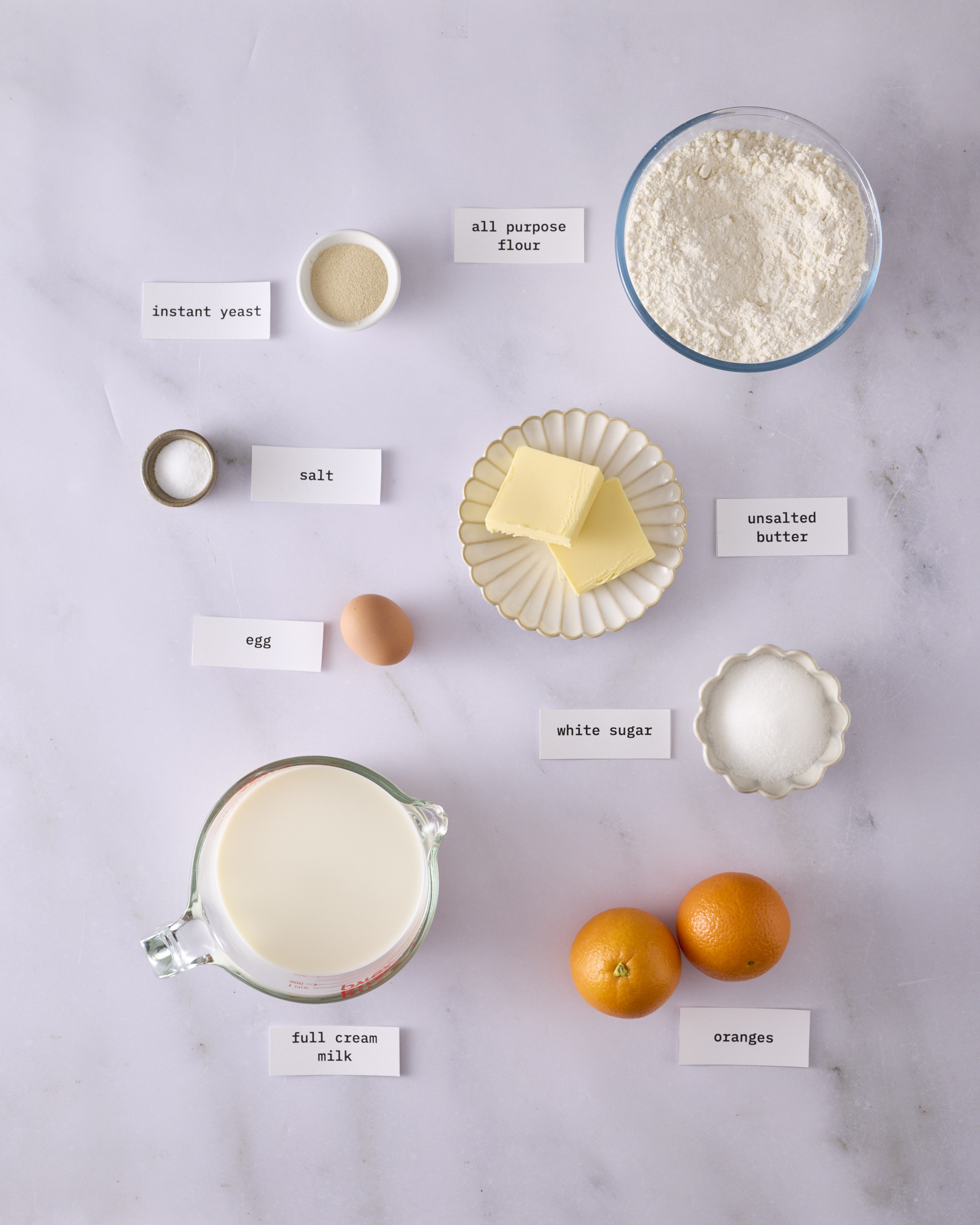
Labelled ingredients for the foundation sweet dough laid out on a marble surface. All-purpose flour, full cream milk, unsalted butter, instant yeast, white sugar, salt, one egg and two oranges.

Tangzhong: 

  • 35g all-purpose flour 
  • 120g full cream milk 
  • ½ teaspoon table salt 

Dough: 

  • 60g white sugar 
  • 2 oranges 
  • 350g full cream milk 
  • 1 large egg 
  • 575g all-purpose flour 
  • 1 tablespoon instant yeast 
  • 115g unsalted butter 

Cardamom filling and sugar

Labelled ingredients for the cardamom filling, cardamom sugar and egg wash for Cardamom Orange Knots laid out on a marble surface: dark brown sugar, cardamom seeds, unsalted butter, eggs, cream, salt and white sugar.

Cardamom filling: 

  • 120g unsalted butter 
  • 200g dark brown sugar 
  • 1 ½ tablespoons ground cardamom seeds 
  • ¼ teaspoon table salt 

Cardamom sugar: 

  • 200g white sugar 
  • 2 tablespoons ground cardamom seeds 

Egg wash: 

  • 2 egg yolks 
  • 1-2 tablespoons cream or milk 

This cardamom knots recipe uses around 3-4 tablespoons of freshly ground cardamom seeds. Referred to as decorticated cardamom seeds, they’re the dark brown seeds found inside the husk of green cardamom pods, and are also sold as whole green cardamom seeds. They’re best used freshly ground, in a spice grinder, personal blender or mortar and pestle if needs be. I order my cardamom seeds online but they are often available at gourmet markets and delis. 

If you can’t find the seeds already removed from their husks, and you have an endless supply of patience, you could remove them by hand from their pods. 

A word of caution about the ground cardamom found in the spice aisle of large supermarkets. It won’t have the same burst of essential oils and citrus-floral taste as fresh ground seeds, since the green cardamom pods have usually been ground whole. But if your only option is to use the supermarket variety of ground cardamom, you may want to increase the amount added to the filling to 2 tablespoons. 

25g package of decorticated cardamom seeds will provide enough ground cardamom for the filling and cardamom sugar in this recipe. 

You can swap out the dark brown sugar for light brown sugar, but I think these orange cardamom buns benefit from the extra hit of molasses flavour from the dark brown sugar.

What to make ahead

Foundation sweet dough

You can absolutely make the foundation sweet dough on the day you want to make this cardamom knots recipe. But that’ll prove to be a long day of baking and isn’t conducive to serving them up to your brunch guests before noon. All in all, better to start the dough the night before you want to bake. 

For a detailed discussion of my foundation sweet dough method and its origin story, you can find that on the Foundation Sweet Dough recipe.

In a rush?

If you don’t want to make the dough the night before and refrigerate it overnight, you can instead leave the kneaded dough on the bench at room temperature for about 2 hours, or until doubled in size, and then proceed with shaping the buns.

Cardamom sugar

I would recommend grinding the 25g package of decorticated cardamom seeds the day before you bake. This will allow you to make the cardamom sugar, and the flavour of the sugar will improve by being made in advance of your baking day. 

For these cardamom orange knots, I grind the cardamom seeds until finely ground but stop short of turning them into powder. Set aside 1 ½ tablespoons for the filling.   

Combine the remaining ground cardamom seeds (up to 2 tablespoons) with 200g white sugar and store the sugar overnight on the bench in a sealed container. Pick a fairly wide shallow container as you will be rolling your baked orange cardamom buns through the sugar.

On the day you bake

Get organised

Before pulling the foundation sweet dough out of the fridge to start forming your kolaches, you need to decide what proving environment you’re able to set up in your kitchen. Commercial bakeries have purpose made proving cabinets with precise settings for temperature and humidity to achieve perfectly risen dough. Proving in a sealed environment also prevents moisture evaporating and airflow causing a skin forming over the dough. 

I have a dough setting on my double oven and set both ovens to 30°C. This higher temperature helps the dough that comes out of the fridge get going faster than if it’s sitting on the bench at room temperature. Unless of course it’s January in Australia, then the bench is fine! 

To help create a moist environment in the oven, I’ve used two very large sturdy plastic bags (70cm x 80cm) that can hold two six-hole Texas muffin tins on a large tray. As I seal up the bag with the tray inside, I blow up the bag with a hair dryer and seal it with a bag clip. If your muffin tins are the larger size and won’t both fit in one bag, use two bags instead, one tin to a bag, over two racks. 

The muffin tins will be fine in a warm oven without the plastic bag on two racks. If you want to add a bit of humidity you can add a bowl of just boiled water in the corner of the oven.

Odds are you don’t, like me, have fifty 70cm x 80cm plastic bags tucked up on the top shelf in the pantry. Have we had the Sandra is a hoarder conversation yet? No bother, another method used by home bakers is proving their bread in large sealed plastic storage containers on the kitchen bench. 

So make your plan and assemble your proving equipment before taking the foundation sweet dough out of the fridge. 

Make the cardamom filling

Cardamom filling creamed together in a glass mixing bowl, smooth and spreadable, with the mixing spoon and empty cardamom bowl beside it.

Place 120g room temperature unsalted butter200g dark brown sugar1 ½ tablespoons ground cardamom seeds, and ¼ teaspoon table salt in the bowl of a stand mixer. Mix on low to medium speed until just combined. Keep the filling at room temperature; you want it to be easily spreadable.  

Assembling the cardamom orange knots

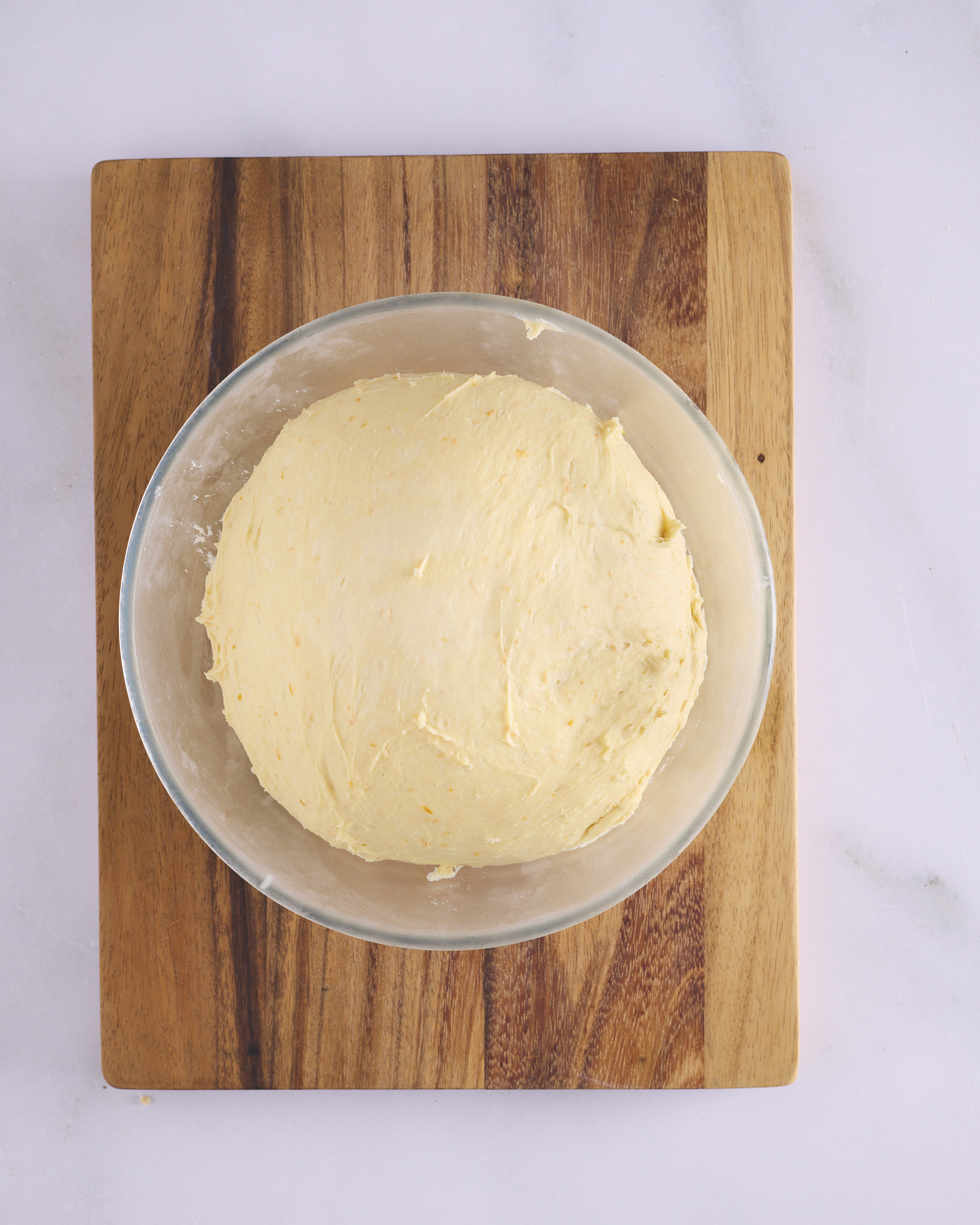
The foundation sweet dough risen in a glass bowl on a wooden board, smooth and domed, with flecks of orange zest through the surface.

Remove the risen dough from the fridge. It does not need to come to room temperature. You want to work with chilled dough. It’s a good idea to clear a shelf in your fridge so the dough shapes can be returned to the fridge as needed while you form the knots.   

Grease two six-hole Texas muffin tins. I prefer to use spray oil but butter works as well.

The foundation sweet dough rolled into a large rectangle on a silicone mat, flecked with orange zest, with a rolling pin, pastry brush, flour sifter, tape measure and dough cutter arranged around it.

The first step in shaping the cardamom orange knots is rolling out the risen dough. The dough is not ‘punched down’ or kneaded at this stage. Rather, the dough is handled gently and shaped into a rough rectangle, then gently rolled into a 45cm x 30cm rectangle. 

The equipment I use to roll out the risen dough includes a large silicone mat (at least 45cm x 30cm), a large rolling pin (at least 35cm long), a measuring tape, a flour shaker, and a pastry brush. 

If you don’t have a silicone mat this size, you can roll the dough out on baking paper instead, though it can be a bit tricky to manage. I wouldn’t recommend rolling straight on the bench unless you’re working quickly and it’s a cold day. 

Before you start rolling, generously flour the silicone mat. Make a routine of brushing away the excess flour as you go. Gently shape the dough into a rough rectangle and start rolling it out. The end result will be around 8mm high. I gently lift the dough and flour the silicone mat again to ensure it doesn’t stick. Flour the surface of the dough and your rolling pin as needed.  

Turn the dough a quarter turn between each roll and measure as you go. And if one side gets a bit too wide, you can gently nudge the dough back in line with the rolling pin.  

If the dough gets too soft to handle, return it to the fridge to firm up. Once you’ve rolled it out into a 45cm x 30cm rectangle, slide it onto a baking tray or other solid flat surface that is big enough to hold the dough flat. Return it to the fridge and let the dough firm up for 15-20 minutes before spreading out the filling.

The rolled foundation sweet dough spread edge to edge with cardamom filling, a silicone spatula resting on top with filling still on it.

Spread the room temperature cardamom filling across the rolled dough using a silicone spatula. Avoid pressing firmly on the dough as you do not want to flatten it as you go. Stop about 5mm shy of the edge of the dough on all sides. Return the dough to the fridge to firm up again for about 10-15 minutes.

The foundation sweet dough rolled and folded in half lengthwise into a long, narrow rectangle, ready to be cut into strips for the cardamom orange knots.

Gently fold the rectangle of dough in half lengthwise, trying to get the edges to meet. It’s OK at this stage to gently encourage the folded dough back into a 45cm x 15cm rectangle. This helps ensure all your cardamom orange knots end up the same size.

Four stages of shaping a cardamom orange knot side by side: a single filled strip of dough, the strip cut lengthwise into three, the three strips loosely braided, and the braided strip rolled into a finished knot.

Don’t forget to grease two six-hole Texas muffin tins.   

Forming the cardamom orange knots is a four-step process. The image above demonstrates what you are aiming to achieve with each step.

Step one

Using a ruler and small paring knife mark out 12 x 3.5cm strips of dough along the long edge of your filled and folded strip of dough. This equates to 42cm of strips of dough, which should leave a couple of centimetres of extra dough out of the 45cm length of dough.   

At this stage you can continue to chill the dough pieces briefly if needed while I work through all the steps. But don’t forget them, as the butter in the filling will go hard and may break up the filling as you try to complete the steps to form the knots.

Step two

Next, use a pastry wheel or paring knife to cut each strip of dough lengthwise into three strips. Be sure not to cut through to the end of the strip; leave about 1cm of dough at the end to hold the three strips together.   

Step three

Loosely braid the three strips and pinch them together when finished.

Step four

Finally, flip the braided strip over and loosely roll it from the pinched tip back up to the end of the strip.  

Place each formed knot with the seam side down in a hole of the Texas muffin tins. Transfer the muffin tins to your proving set up. See the detailed explanation above under the heading – ‘get organised.’  

As I have compact Texas muffin tins, I place both tins on a large baking sheet inside a large plastic bag, billowing the bag as I go so it doesn’t catch on the dough. Then I twist the bag closed and blow it up to create a dome with a hairdryer (on the cool setting). This goes onto the middle rack in the oven set at 30°C. 

Proving time will depend on your proving set up and the ambient temperature of that environment. You are aiming for the orange cardamom buns to be just under doubled in size. My method takes 30-40 minutes. And remember that the dough started cold from the fridge, so the yeast will take a while to get going.   

Meanwhile, prepare the egg wash by beating 2 egg yolks and 2 tablespoons cream or milk together in a small bowl.   

Preheat the oven to 165°C fan forced (note the temperature is turned down to 155°C fan forced immediately after the knots go into the oven). 

A dozen unbaked cardamom orange knots proved in two six-hole Texas muffin tins, with a bowl of egg wash and a paintbrush beside them.

Gently brush the risen knots with egg wash. I use a small paintbrush so I can ensure each strip of dough is evenly covered. I do two layers of egg wash, aiming to avoid the filling as I go. Brush all twelve knots with a thin layer and then start again. Using thin layers will help avoid the egg wash pooling at the bottom of the muffin tin holes. 

When baking over two racks, have one tray at the top third of the oven and the second at the bottom third of the oven. Swap the trays when the top tray starts to turn golden. Also rotate the trays 180 degrees at the same time. If baking across two ovens, put the racks in the middle of the oven and turn the trays 180 degrees halfway through the bake. 

Once the trays are placed in the 165°C fan forced oven, immediately turn the temperature down to 155°C fan forced. 

While the buns are baking, get out the cardamom sugar and place it in a wide shallow bowl. Have a non-stick cooling rack ready as well. 

Baking time for the cardamom orange knots will be around 20 minutes. I am an advocate for the certainty of an instant read thermometer. The target internal temperature for the bun itself is 88°C to 91°C. I start checking the buns at the 15-minute stage. 

Let the baked knots cool in the tins for a few minutes. It’s important to coat the knots when they are hot out of the oven or the sugar won’t stick to the buns. But watch out for any molten sugar lurking at the bottom of the muffin holes. I wear plastic food handling gloves and use a small offset spatula to gently tip the knots out of the tins one at a time into the cardamom sugar. Using a combination of sprinkling and rolling through the sugar, cover the cardamom orange knots with the sugar. Then leave the knots to cool completely on the non-stick cooling rack. 

A plate of cardamom orange knots, one torn open to show the spiralled cardamom filling inside, with mugs of coffee on a linen napkin in the background.

These Swedish cardamom buns are best eaten on the day they are made. Perfect for a Swedish-inspired fika or coffee break. They freeze well too, but given how deliciously addictive these cardamom orange knots are, I doubt there will be any left to freeze. 

And however your first batch turns out, imperfect knots included, I promise it’ll still taste every bit as good as the ones lining up in my Instagram feed. If my control issues haven’t put you off by now, my foundation sweet dough has a couple of other bakes worth taking it to next. 

Cardamom Orange Knots

A dozen Cardamom Orange Knots arranged on parchment paper, each one twisted into a knot shape and finished with a golden, cardamom-sugared crust.
If you were to ask me, cinnamon roll or cardamom bun, the adult me answers "cardamom bun" every time. But the kid me would be asking "what's a cardamom?" I have, without remorse or a look back at my childhood love, fallen hard for the Swedish kardemummabullar or cardamom bun.
I have yet to make it to Sweden to try the most authentic kardemummabullar but I have sampled every version I come across at the local artisan bakeries I find while travelling. I am particularly fond of the knot version, kardemummaknutar. Clearly, I am not alone in this regard considering the number of cardamom knot tying reels that drop into my Instagram feed.
Prep Time 50 minutes
Cook Time 20 minutes
Inactive Time 14 hours
Course Breakfast, Brunch, Freezes
Cuisine Swedish
Servings 12

Equipment

  • Two six-hole Texas muffin tins
  • Digital kitchen scales
  • Large silicone mat (at least 45cm x 30cm)
  • Large rolling pin (at least 35cm long)
  • Instant read thermometer

Ingredients  

Foundation sweet dough

Tangzhong:

  • 35 g all-purpose flour
  • 120 g full cream milk
  • ½ teaspoon table salt

Dough:

  • 60 g white sugar
  • 2 oranges
  • 350 g full cream milk
  • 1 large egg
  • 575 g all-purpose flour
  • 1 tablespoon instant yeast
  • 115 g unsalted butter

Cardamom filling:

  • 120 g unsalted butter
  • 200 g dark brown sugar
  • 1 ½ tablespoons ground cardamom seeds
  • ¼ teaspoon table salt

Cardamom sugar:

  • 200 g white sugar
  • 2 tablespoons ground cardamom seeds

Egg wash:

  • 2 egg yolks
  • 1-2 tablespoons cream or milk

Instructions 

What to make ahead

    Make the tangzhong:

    • Weigh 35g all-purpose flour and 120g full cream milk into a small pan and add ½ teaspoon table salt.
    • Heat over medium low heat while whisking until the mixture forms a thick paste.
    • Remove from the heat, transfer to a small bowl or container and chill until slightly cold.

    Make and knead the foundation sweet dough:

    • Weigh 60g white sugar into the bowl of a stand mixer and zest 2 oranges over the bowl using a Microplane.
    • Using the paddle attachment, mix on medium for 2 minutes until zest is well incorporated into the sugar.
    • Add the tangzhong, 350g full cream milk, 1 large egg, 575g all-purpose flour, and 1 tablespoon instant yeast.
    • Mix on low with the dough hook until combined.
    • Increase speed to medium and knead for at least 5 minutes to develop the gluten. You want it to stretch and not tear immediately if you test a small piece of the dough.
    • Turn the speed back to low and add 115g slightly chilled unsalted butter, cut into tablespoon sized pieces, a couple of pieces at a time. Wait until each addition is incorporated before adding more. This can take up to 10 minutes.

    Forming the dough ball:

    • Tip the dough onto the bench. Pick a side to be the top of the dough ball and keep it that way.
    • Lift the dough off the bench, stretch it out and drop it back down, gathering it back into a ball with a dough scraper.
    • Repeat until the dough becomes less sticky and more resistant.
    • Then lift the dough about 30cm off the bench, letting it stretch into a tail, flip the tail forward as you land it, roll the dough over and tuck it in, keeping the top facing up. Tuck in around the base with the scraper and repeat a couple of times.
    • The dough is ready when it releases cleanly from the bench and springs back when pressed.
    • Lift into a greased bowl, cover with an oiled sealed lid or oiled plastic wrap.
    • Refrigerate overnight, up to 12 hours.

    Cardamom sugar:

    • Grind the 25g package of decorticated cardamom seeds, finely but not to a powder.
    • Set aside 1 ½ tablespoons of the ground cardamom for the filling.
    • Combine the remaining ground cardamom, up to 2 tablespoons, with 200g white sugar.
    • Store in a wide, shallow, sealed container on the bench overnight.

    Get organised:

    • Set up your proving environment before taking the dough out of the fridge.
    • Set the oven to 30°C.
    • Grease two six-hole Texas muffin tins.

    Assembling the cardamom orange knots:

    • Remove the risen dough from the fridge. It does not need to come to room temperature; you want to work with chilled, not soft, dough.
    • Roll the dough out on a well-floured silicone mat into a 45cm x 30cm rectangle, about 8mm thick.
    • If the dough gets too soft to handle, return it to the fridge to firm up. No mat this size? Baking paper works too, though it's a bit trickier to manage.
    • Slide the rolled dough onto a flat tray, return to the fridge, and let it firm up for 15-20 minutes.
    • Spread the room temperature cardamom filling across the dough with a silicone spatula, stopping about 5mm short of the edges on all sides.
    • Return the dough to the fridge to firm up again for 10-15 minutes.
    • Fold the rectangle in half lengthwise, edges meeting, and gently shape back into a 45cm x 15cm rectangle using the rolling pin.
    • Mark and cut 12 x 3.5cm strips along the long edge of the folded dough.
    • Cut each strip lengthwise into three, leaving about 1cm uncut at one end to hold them together.
    • Loosely braid the three strips and pinch the ends together.
    • Flip the braided strip over and loosely roll it from the pinched end back to the other end, creating the effect of a knot.
    • Place each knot seam-side down into a hole of the prepared muffin tins.
    • Transfer to your proving set up and prove until just under doubled in size, 30-40 minutes.
    • Meanwhile, prepare the egg wash by beating 2 egg yolks with 1-2 tablespoons cream or milk.

    Bake:

    • Preheat the oven to 165°C fan forced.
    • If baking over two racks, have one tray at the top third of the oven and the second at the bottom third of the oven. Swap the trays when the top tray starts to turn golden. Also rotate the trays 180 degrees at the same time.
    • Brush the risen knots with a thin layer of egg wash, avoiding the filling. Repeat with a second thin layer.
    • Once in the oven, immediately turn the temperature down to 155°C fan forced.
    • Bake for around 20 minutes, checking from the 15-minute mark. The internal temperature of the bun should reach 88°C to 91°C.
    • Let the knots cool in the tins for a few minutes.
    • Working quickly while the knots are still hot, gently remove the knots from the tins and tip them one at a time into the cardamom sugar. Use a combination of sprinkling and rolling to coat them.
    • Leave to cool completely on a wire rack.

    Just before you cook with abandon…

    Cardamom: For the best flavour, grind your own decorticated cardamom seeds rather than using pre-ground cardamom from the supermarket spice aisle, which won't have the same burst of essential oils and citrus-floral taste. If you're using the supermarket variety, increase the amount in the filling to 2 tablespoons. A 25g package of decorticated seeds gives you enough ground cardamom for both the filling and the cardamom sugar.
    Sugar: You can swap the dark brown sugar for light brown, though the dark brown sugar's molasses flavour is worth keeping if you can.
    Get organised: Mise en place, or putting in place, is harder when a recipe runs across two days, so treat it as two lots of being organised. Weigh and set out each component as you make it, and on bake day get your proving environment set up and your muffin tins greased before the foundation sweet dough comes out of the fridge. The dough is easiest to handle while it's still cold, and that window closes while you're hunting for a rolling pin.
    Digital scales: If you are going to bake, you need a kitchen scale. It's really in the necessity column not the optional column. You don't need to spend a fortune on them; decent ones can be bought for about $70. I find the expensive ones break down just as quickly as the cheaper versions. But I would recommend you go for a known brand from a reputable kitchen shop.
    Tablespoons: I use 15ml tablespoons in my baking recipes.
    Make ahead: The night before you bake, make the tangzhong, knead the foundation sweet dough and get it into the fridge for its overnight rest, and make the cardamom sugar so it has time to develop overnight. That leaves the cardamom filling, rolling, shaping and baking for the day itself.
    Proving without a proving oven: I use one very large sturdy plastic bag (70cm x 80cm) that holds both six-hole Texas muffin tins together on a large tray, inflated with a hair dryer so it doesn't catch on the dough, then prove in the oven set to 30°C. If your muffin tins are the larger size and won't both fit in one bag, use two bags instead, one tin to a bag, over two racks. The tins will be fine on two racks in a warm oven without the bags too—add a bowl of just boiled water in the corner of the oven if you want the humidity. Large sealed plastic storage containers on the bench work as well. And if it's January in Australia, the bench is fine on its own.
    Storage: The tangzhong method used in these cardamom orange knots helps keep them fresh—moist and fluffy—for a couple of extra days. I keep them in the fridge in a sealed container and refresh them with a few minutes in a low oven at around 120°C until they're warmed through.
    Freezing: These cardamom orange knots can be frozen at more than one stage. Once shaped and placed in the tins, they can be frozen before proving rather than baked straight away—freeze until solid, then transfer to an airtight container. To use, thaw in the fridge overnight, then let the knots come up to room temperature and prove as normal before baking, building in extra time since this takes longer than an unfrozen prove. Or freeze them once baked and completely cooled, in a sealed container. To reheat, microwave one for 30 seconds on high, then pop it in a low oven at around 120°C until it's warmed through.
    Keyword cardamom knots recipe, cardamom orange knots, orange cardamom buns, Swedish cardamom buns

    Leave a Reply

    Your email address will not be published. Required fields are marked *

    Recipe Rating


    Hi, I'm Sandra!

    I live by the words of Harriet Van Horne and I will be exploring every possible way to bring Harriet’s words to life in my kitchen.

    Recipes

    Discover delicious featured food recipes! From quick meals to gourmet delights, Sandra offer inspiring dishes for every occasion. Explore, cook, and enjoy flavorful creations today.

    You might also like..

    Easy Homemade Egg Pasta

    My Best Lasagna Yet

    BBQ Massaman Curry Lamb Shanks

    Pretty In Pink Devil’s Food Cake

    Subscribe

    Subscribe to my newsletter for a chance to win a FREE APRON (drawn monthly) as well as cooking tips, recipes, offers and exclusive content.

    "*" indicates required fields